
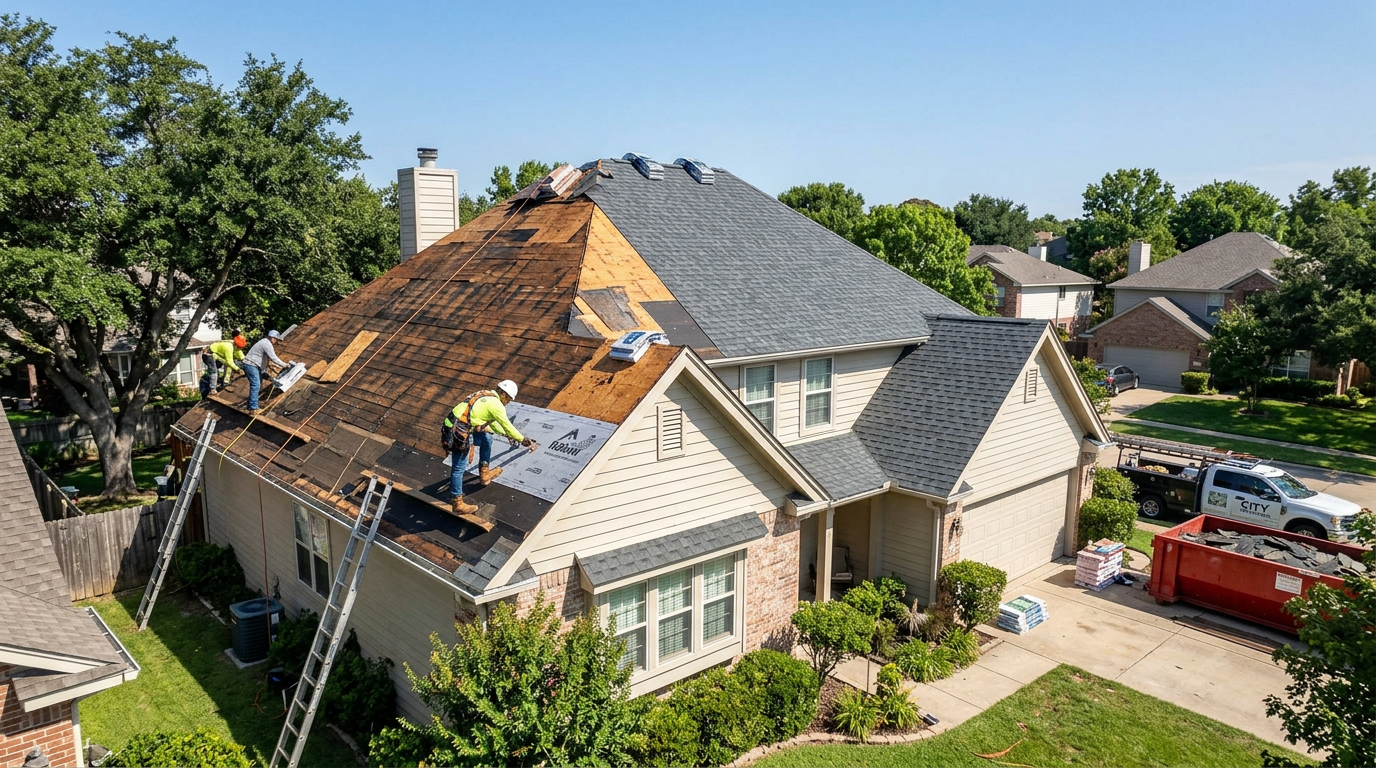
How Much Does a Roof Replacement Cost in 2026?
- Most residential roof replacements fall between $8,000 and $22,000 — the wide range reflects material choice, roof size, and local labor rates more than anything else
- Architectural asphalt shingles are the most common choice at $4.50–$7.50 per square foot installed, offering the best balance of cost, durability, and appearance
- Labor typically accounts for 40–60% of total project cost — regional labor rates can shift your final price by 20–35% compared to the national average
- Budget an additional 10–20% for unknown costs: damaged decking, failing flashing, and code-required upgrades are routinely discovered once tear-off begins
- When cumulative repair costs exceed 30% of replacement value — or your roof is past 75% of its expected lifespan — replacement almost always delivers better long-term value
A roof replacement is one of the largest single-trade projects most homeowners will ever undertake. Unlike a kitchen remodel where you can phase costs over time, a failing roof demands a complete solution on a compressed timeline. Understanding what drives cost — and what the numbers actually mean — lets you negotiate from a position of knowledge rather than anxiety.
This guide breaks down every cost layer: material, labor, size, complexity, region, and the hidden line items that inflate nearly every roofing project. If you’re still evaluating whether you need a replacement at all, start with our guide to signs you need a new roof before working through the numbers here.
Average Roof Replacement Cost in 2026
The single number most commonly cited online — “the average roof replacement costs $12,000” — obscures more than it reveals. A 1,200-square-foot ranch in the Midwest with standard architectural shingles and a simple roofline costs far less than a 2,800-square-foot colonial in a coastal market with multiple dormers and a steep pitch.
Here are realistic installed cost ranges by house size for architectural asphalt shingles, the most widely installed material in the U.S.:
| Home Size (sq ft) | Roof Area Estimate | Installed Cost Range |
|---|---|---|
| 1,000–1,500 | 1,100–1,700 sq ft | $6,500–$11,000 |
| 1,500–2,200 | 1,700–2,500 sq ft | $10,000–$16,000 |
| 2,200–3,000 | 2,500–3,400 sq ft | $14,000–$22,000 |
| 3,000+ | 3,400+ sq ft | $20,000–$35,000+ |
These ranges assume a standard pitch, a single layer of existing shingles, and no significant decking damage. Projects with steep slopes, multiple roofing planes, or discovered decking problems routinely land above the upper end.
Cost by Roofing Material
Material is the single biggest lever you control on a roofing project. The difference between 3-tab asphalt and slate isn’t just aesthetic — it’s a 6x price gap and a 40-year difference in expected lifespan.
All costs below are installed price per roofing square (100 square feet):
| Material | Installed Cost per Square | Expected Lifespan | Notes |
|---|---|---|---|
| Asphalt 3-tab | $350–$500 | 15–20 years | Cheapest option; fewer contractors recommend it in 2026 |
| Architectural (dimensional) asphalt | $450–$750 | 25–30 years | Most popular; thicker profile, better wind rating |
| Premium asphalt (designer) | $700–$1,100 | 30+ years | Mimics wood shake or slate; heavier underlayment needed |
| Metal standing seam | $900–$1,600 | 40–70 years | Excellent in snow/rain regions; requires experienced installer |
| Metal panels (exposed fastener) | $600–$1,000 | 30–45 years | Less expensive than standing seam; slightly less weather-tight |
| Clay or concrete tile | $1,000–$2,000 | 40–50+ years | Adds 7–12 lbs per sq ft; may require structural assessment |
| Slate (natural) | $1,500–$3,500 | 75–150 years | Premium choice; supply limited, installer pool is small |
The lifespan column matters as much as the installed cost when you’re doing a long-term calculation. A metal standing seam roof that costs twice as much as architectural shingles may be the cheaper option if you plan to stay in the home for 20+ years and avoid a second replacement.
Cost by Roof Size and Complexity
Roofing contractors price work by the “square” — 100 square feet of roof surface area. Your roof surface area is not the same as your home’s square footage. A home’s roof area is calculated by multiplying floor area by a pitch factor that accounts for slope.
Pitch multipliers by slope:
| Pitch (rise per 12” run) | Pitch Category | Multiplier |
|---|---|---|
| 4:12 to 6:12 | Low to moderate | 1.15–1.25x |
| 6:12 to 9:12 | Moderate to steep | 1.25–1.40x |
| 9:12 to 12:12 | Steep | 1.40–1.55x |
| 12:12+ | Very steep / walking pitch | 1.55x+ |
Beyond pitch, complexity factors add cost in ways many homeowners don’t anticipate:
- Valleys: Each roof valley requires careful flashing and extra material. A roof with six valleys costs meaningfully more to install than one with two.
- Dormers: Dormer intersections are labor-intensive and failure-prone. Expect $300–$700 per dormer in added labor.
- Chimneys and skylights: Each penetration requires custom flashing. Chimney reflashing alone runs $200–$500; skylight flashing is $150–$350 per unit.
- Multiple rooflines: A home with multiple roof planes — common on Craftsman and Victorian styles — requires more cuts, waste material, and skilled labor than a simple gable.
Labor Costs
Labor accounts for 40–60% of a typical roof replacement quote. On a $14,000 project, that’s $5,600–$8,400 going to the crew. Understanding what drives labor costs helps you evaluate quotes more accurately.
What roofers charge for labor:
Most contractors price labor by the square ($75–$200 per square depending on region and complexity) or bundle it into a per-square all-in price. Crew size, experience level, and local prevailing wages all feed into the final number.
Factors that increase labor costs:
- Steep pitch: Crews work slower, need safety equipment, and take on more physical risk above 8:12
- Height: Two-story and three-story homes require longer ladders, more equipment, and greater safety precautions
- Time of year: Peak season (May–September) in most markets sees higher labor rates and longer lead times
- Speed requirements: Emergency or fast-track scheduling commands a premium
- Disposal logistics: Difficult site access increases dumpster placement and materials handling time
Trade breakdown on a typical $15,000 project:
| Cost Component | Approximate Share |
|---|---|
| Labor (installation + tear-off) | 40–55% |
| Roofing material (shingles, underlayment) | 30–40% |
| Flashings, ice and water shield, ridge cap | 5–10% |
| Permits and disposal | 3–7% |
Regional Price Variation
Labor costs, material shipping distances, contractor density, and local code requirements all drive regional price differences. A roof that costs $12,000 in Kansas City could easily run $17,000–$19,000 in San Francisco or Boston.
| Region | Cost Multiplier vs. National Average |
|---|---|
| Midwest (IL, OH, MN, MO) | 0.85–0.95x |
| South (TX, GA, TN, SC) | 0.80–0.95x |
| Southeast coast (FL, AL) | 0.90–1.05x (hurricane code adds cost) |
| Mountain West (CO, UT, AZ) | 0.95–1.10x |
| Pacific Northwest (OR, WA) | 1.10–1.25x |
| California (major metros) | 1.25–1.50x |
| Northeast (NY, MA, CT, NJ) | 1.20–1.40x |
These multipliers apply primarily to labor. Material costs vary less by region — asphalt shingles are manufactured and distributed nationally — but freight costs for heavy materials like tile or slate can add $0.50–$1.50 per square foot in remote markets.
Ready to Get Started?
Enter your zip code for free quotes from local pros.
Additional Costs Most Homeowners Miss
The quote you receive is rarely the final invoice. Roofing projects carry a higher rate of mid-project cost surprises than almost any other trade, because the full condition of the roof can’t be assessed until tear-off begins. Budget for these common additions.
Decking repair and replacement
Roof decking (OSB or plywood sheathing beneath the shingles) absorbs moisture damage silently over years. Minor soft spots may require replacing individual 4x8 sheets at $80–$150 per sheet including labor. Widespread rot can add $800–$3,000 or more to a project.
Tear-off of existing layers
If your roof currently has two layers of shingles — common on homes that had a second layer added over the first — tear-off costs are roughly double. Removing two layers generates significantly more debris and labor. Most jurisdictions require complete tear-off before a new installation regardless of layer count; some still allow two layers, but experienced contractors generally recommend against it.
Tear-off labor and disposal typically runs $1–$2 per square foot, or $1,000–$3,500 on an average home.
Permits
Roof replacement permits are required in most municipalities. Costs range from $100 to $600 depending on your jurisdiction. Some contractors include permits in their quotes; many don’t. Confirm this explicitly before signing.
Dumpster rental
If your contractor doesn’t handle debris disposal, standalone dumpster rental runs $350–$600 for a typical roof project. Most full-service contractors include this in their quote.
Gutter replacement
It’s common to replace gutters at the same time as a roof replacement, since fascia is often being touched anyway. New gutters run $8–$15 per linear foot installed — $1,500–$3,500 for a typical home.
Flashings
Roof flashings — the metal pieces sealing transitions at chimneys, walls, skylights, and valleys — degrade at a different rate than shingles. New flashings add $200–$600 depending on the number of penetrations and are strongly recommended during any full replacement.
Roof Replacement vs. Roof Repair
This is fundamentally a cost-decision question, not just a condition question. The right answer depends on where your roof sits in its lifecycle and how repair costs stack up against replacement.
The 30% rule
If the cumulative cost of needed repairs exceeds 30% of the cost of a full replacement, replacement almost always delivers better value. A $15,000 replacement decision becomes straightforward if you’re looking at $5,000+ in patches that don’t address aging underlayment or worn-out flashings.
Age-based thresholds
- Under 40% of expected lifespan: Repairs are usually appropriate if damage is localized
- 40–75% of expected lifespan: Evaluate total repair cost against replacement; consider financing
- Over 75% of expected lifespan: Replacement is almost always more economical — you’re extending a system that will need full replacement within 5–8 years anyway
The insurance angle
If your roof damage stems from a covered peril (hail, wind, falling tree), your homeowner’s insurance may cover replacement cost value or actual cash value. Before authorizing any repair — even a temporary patch — contact your insurer and document damage with photos. Emergency repairs needed to prevent further loss are generally covered; non-emergency cosmetic repairs often aren’t. Insurance claims for roofs are time-sensitive, with many policies requiring claims within 12 months of a storm event.
When repairs make financial sense
Repairs are genuinely the better choice when: the roof is less than 10 years old, damage is localized to a single slope or section, the underlying decking and flashing are in good condition, and a matching shingle is still available from the original manufacturer.
How to Get the Best Price
Timing matters. Roofing is a seasonal business. Demand peaks from late spring through early fall. If your situation isn’t urgent, scheduling your replacement for late fall (October–November) or early spring often yields 5–15% lower pricing as contractors fill their calendars.
Get at least three quotes. For a project of this size, three written quotes from licensed, insured contractors is a minimum. You’re not looking for the lowest number — you’re looking for a clear breakdown that lets you compare what you’re actually getting. A quote $2,000 lower than competitors may be using lighter underlayment, skipping new flashings, or planning to leave the old decking in place. Our guide on how to choose a roofing contractor covers exactly what to verify before signing.
Ask about material upgrades. Moving from a standard architectural shingle to a premium 50-year shingle often adds only $800–$1,500 on a mid-size home — a fraction of total project cost for significantly better long-term protection. Get a quote for the step-up and evaluate it against the lifespan difference.
Understand the warranty structure. Roofing warranties have two components: the manufacturer’s material warranty (15–50 years on shingles) and the contractor’s workmanship warranty (typically 1–10 years). Manufacturer-certified contractors can often offer enhanced warranties — GAF Master Elite or CertainTeed Select ShingleMaster, for example — that require specific installation standards. These certifications are worth asking about.
Financing is widely available. Most roofing contractors offer financing through third-party lenders. Rates vary significantly, so compare the contractor’s financing offer against a HELOC, home equity loan, or personal loan before committing. For a $15,000 project, a 2% rate difference over 60 months is roughly $900 in additional interest.
FAQ
How long does a roof replacement take?
Most residential roof replacements are completed in one to three days once the project starts. Larger or more complex roofs — multiple stories, steep pitch, extensive dormers — may take three to five days. Weather delays are common. Your contractor should give you a project timeline and communicate proactively about weather-related postponements.
Does replacing my roof increase home value?
Yes, though typically not dollar-for-dollar. Remodeling industry data consistently shows roof replacement recoups 50–70% of its cost in resale value — meaning a $14,000 roof may add $7,000–$10,000 to your sale price. The bigger value is in buyer confidence: homes with aging roofs often trigger contingencies, price negotiations, or deal failures during inspection. A new roof removes a significant friction point.
What’s the difference between architectural and 3-tab shingles?
Three-tab shingles are a single flat layer with cutouts that create the appearance of three separate shingles. Architectural (dimensional) shingles use multiple bonded layers to create a thicker, textured profile. Architectural shingles are heavier, better rated for wind and impact, carry longer warranties, and look more upscale. The price difference is typically $50–$150 per square installed — a gap that has narrowed significantly as demand for 3-tab has declined over the past decade.
How do I know if my contractor is legitimate?
A legitimate roofing contractor should carry general liability insurance (minimum $1 million) and workers’ compensation insurance, hold a valid contractor’s license in your state (requirements vary), have a physical business address and verifiable history, and pull permits themselves rather than asking you to do it. Ask for certificates of insurance directly from the contractor’s insurer — not just a copy from the contractor. Roofing has a high rate of transient contractors, especially after storms.
Can I replace my roof in winter?
Yes, though with caveats. Asphalt shingles require temperatures above approximately 40°F to properly seal — below that, the adhesive strips don’t activate and shingles can crack during installation. Experienced contractors in cold climates have techniques for cold-weather installation, including hand-sealing each shingle. If you need a roof replacement in winter, confirm your contractor is experienced with cold-weather work and that your contract specifies warranty coverage for the installation method used.
How long should I expect a new asphalt shingle roof to last?
Architectural asphalt shingles carry 25–30 year warranties and realistically last 20–30 years depending on climate, attic ventilation, and maintenance. In harsher climates — high UV exposure, heavy snow load, frequent temperature cycling — lifespans trend toward the lower end. Metal and tile roofs last significantly longer (40–70 years for metal, 40–50+ for tile), which factors into the long-term cost math when comparing materials.
Get Started
You now have the cost framework — material ranges, labor shares, regional multipliers, and the hidden line items that inflate most projects. The next step is getting real numbers for your roof. Quotes vary significantly based on what each contractor includes in their scope, so comparing at least three written estimates side by side is how you find the right balance of price and quality for your project.
Enter your zip code below to get matched with licensed, insured roofing contractors who can measure your roof, assess the tear-off and decking situation, and provide a written scope of work you can compare.