
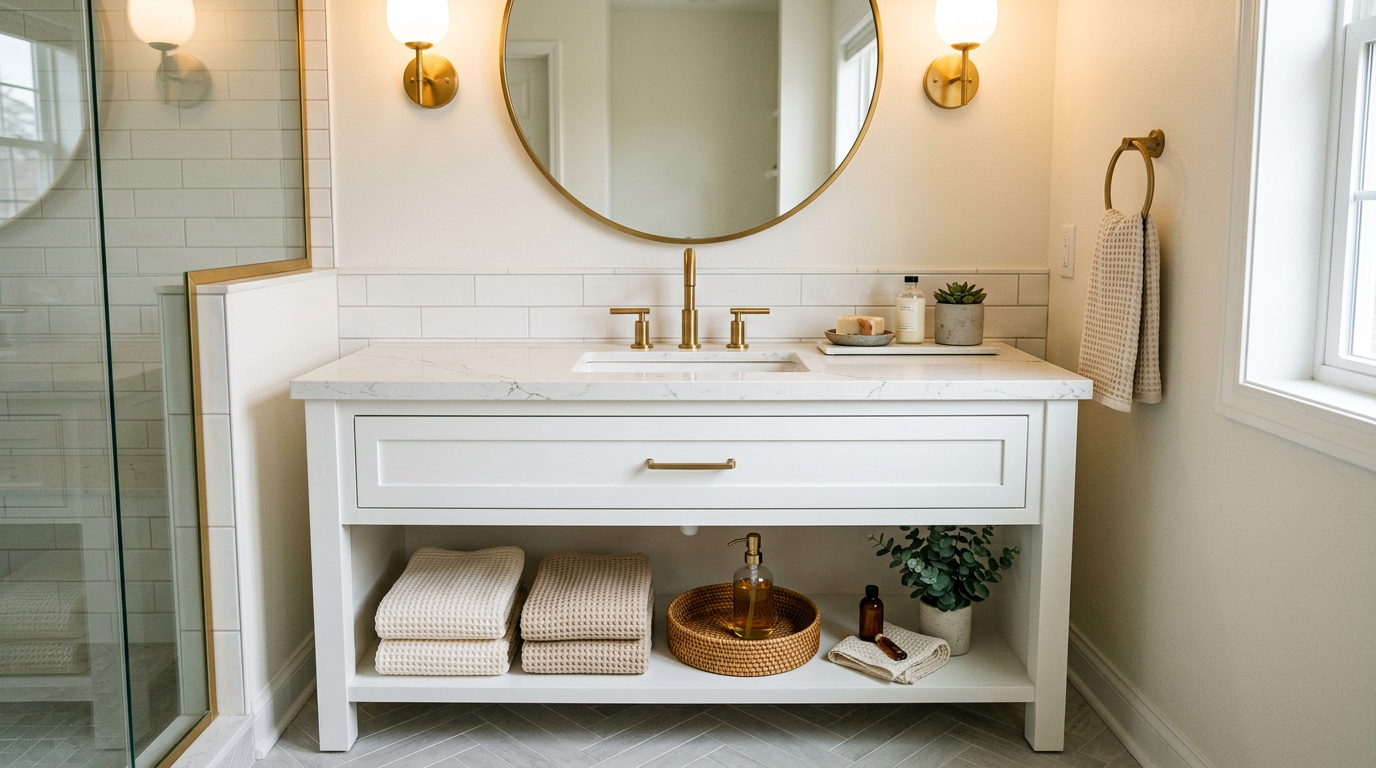
How to Choose a Bathroom Vanity: Sizes, Styles, and What to Look For
- Measure your rough-in space first — width, depth, and door/drawer clearance — before shopping
- Standard vanity height is 32–34"; comfort height (35–36") is now the dominant choice in remodels
- Solid wood and plywood construction outperform MDF and particle board in humid bathrooms
- Quartz is the most practical countertop: non-porous, stain-resistant, and competitively priced
- Single vanities run 24–48" wide; double vanities start at 60" — confirm your plumbing locations before committing to a size
- Budget $200–$500 for entry-level, $500–$1,500 for mid-range, and $1,500–$5,000+ for custom or semi-custom
How to Measure Your Bathroom for a Vanity
Measuring correctly before you shop eliminates the most common — and most expensive — mistake: buying a vanity that doesn’t fit.
- Measure the wall width where the vanity will sit, from corner or wall to the nearest obstruction
- Note the location of the drain and supply lines — they must align with the new vanity's plumbing cutouts
- Measure depth from the wall to any obstructions (door swing, toilet, shower edge) — standard vanities are 18–22" deep
- Measure floor-to-ceiling height if you're adding a mirror, medicine cabinet, or tall linen tower
- Check door swing clearance: a vanity drawer or door should not block the bathroom entry door when open
- Account for baseboard trim — if it runs behind the vanity location, the vanity body must clear it or it needs to be notched
- Mark stud locations in the wall if you're installing a wall-mounted (floating) vanity
- Confirm the rough-in dimensions: supply line spacing (typically 8" apart) and drain height from finished floor
Standard Vanity Sizes
Vanities come in standardized widths that correspond to common bathroom layouts. Knowing the options prevents you from falling in love with a size that won’t work in your space.
Single-Sink Vanity Widths
| Width | Best For | Typical Use Case |
|---|---|---|
| 24” | Very small bathrooms, powder rooms | Guest bath, half bath |
| 30” | Small to mid-size bathrooms | Primary guest bath |
| 36” | Mid-size bathrooms | Primary bath with limited space |
| 42” | Mid-size to large bathrooms | Good storage without double sink |
| 48” | Large single-sink setups | Primary bath, aging-in-place layouts |
Double-Sink Vanity Widths
| Width | Notes |
|---|---|
| 60” | Minimum for two sinks — tight but functional |
| 72” | Standard double vanity, comfortable spacing |
| 84”–96” | Luxury/primary suite; uncommon in pre-built options |
Vanity Height
Standard vanity height (top of counter) has historically been 32–34”. Comfort height, also called ADA-compliant height, runs 35–36” and has become the default choice in modern remodels because it reduces back strain for adults of average height.
- 32–34”: Traditional height; better for households with children
- 35–36”: Comfort height; preferred in primary baths, aging-in-place applications
Vanity Depth
| Depth | Category | Notes |
|---|---|---|
| Under 16” | Narrow/wall-mount | Maximizes floor space; limited storage |
| 18–19” | Narrow standard | Good for small bathrooms |
| 20–22” | Standard | Most pre-built vanities |
| 24” | Deep | Custom and semi-custom units |
If your bathroom is under 40 square feet, a narrow vanity (16–19” deep) prevents the space from feeling cramped.
Types of Bathroom Vanities
Freestanding
The most common type. The cabinet sits on the floor and conceals plumbing. Available at every price point from big-box stores to custom cabinet shops. Easy to install and replace. Most pre-built vanities are freestanding.
Best for: Any bathroom where storage is a priority.
Wall-Mounted (Floating)
The cabinet is mounted to wall studs with no floor contact. Creates an open, modern look and makes floor cleaning easier. Requires solid blocking in the wall (typically a 2×8 board between studs) to support weight.
Best for: Small bathrooms where visual openness matters; modern or minimalist design styles.
Built-In (Furniture-Style)
A freestanding cabinet designed to look like furniture, often with legs, feet, or decorative panels. More traditional aesthetic. Less water-resistant at the base than frameless cabinets but popular for farmhouse and transitional styles.
Best for: Traditional, farmhouse, or transitional bathroom designs.
Corner Vanity
A triangular or angled cabinet designed for corner placement. Maximizes otherwise wasted space in very small bathrooms. Limited storage and hard to find in appealing styles.
Best for: Very small bathrooms or powder rooms under 30 square feet.
Vessel Sink Vanity
A lower cabinet (typically 28–32” tall) paired with a vessel sink sitting above the countertop surface. The combined height hits the 34–36” range. Creates a dramatic focal point.
Best for: Statement bathrooms; works best when paired deliberately with the vessel sink style.
Cabinet Construction and Materials
Cabinet construction is where long-term durability is decided. Bathrooms are high-humidity environments — the wrong materials fail within a few years.
| Material | Moisture Resistance | Durability | Cost | Verdict |
|---|---|---|---|---|
| Solid wood | Good (when sealed) | Excellent | High | Best long-term but can warp without proper sealing |
| Plywood | Very good | Excellent | Mid–high | Best value for durability; resists warping better than solid wood |
| MDF (medium-density fiberboard) | Poor | Moderate | Low–mid | Fine for dry climates; swells and delamulates near water |
| Particle board | Very poor | Low | Low | Avoid — fails quickly in bathroom conditions |
Construction grades to look for:
- Dovetail drawer joints: Strongest wood joint; standard on quality vanities
- Soft-close hinges and drawer guides: Indicates overall quality of hardware
- Plywood box construction: Interior cabinet box material matters as much as the face frame
Countertop Options
The countertop is one of the most visible elements and has a major impact on both cost and daily maintenance.
| Material | Cost (installed) | Pros | Cons |
|---|---|---|---|
| Quartz | $50–$120/sq ft | Non-porous, stain-resistant, consistent pattern | Price varies; man-made appearance |
| Granite | $40–$100/sq ft | Natural look, heat-resistant, durable | Requires annual sealing; inconsistent slabs |
| Marble | $60–$150/sq ft | Luxury aesthetic, unique veining | Porous, etches with acidic products, high maintenance |
| Cultured marble | $15–$40/sq ft | Affordable, seamless with integrated sink | Dated look, scratches easily |
| Laminate | $10–$30/sq ft | Lowest cost, wide pattern options | Chips at edges, degrades with water exposure |
For most bathrooms, quartz delivers the best combination of durability, low maintenance, and appearance. Marble is beautiful but only practical if you’re willing to seal it twice a year and avoid harsh cleaners.
Sink Types
The sink type determines your countertop requirements, plumbing rough-in needs, and cleaning effort.
Undermount
Mounted below the countertop surface. The cleanest, most hygienic option — no rim to collect debris. Requires a solid-surface countertop (quartz, granite, marble) that can be cut and finished at the edge. This is the dominant choice in mid-range and high-end vanities.
Vessel
Sits entirely above the counter surface. Bold visual statement, pairs with lower vanity cabinets. Difficult to clean around the base; water collects where the vessel meets the counter.
Integrated (Molded-In)
Sink and countertop are a single continuous piece (common in cultured marble and solid surface). No seams to collect mold. Easiest to clean. Limited style options.
Drop-In (Self-Rimming)
The sink drops into a cut hole and the rim rests on top of the counter. Easiest to install and replace. The rim creates a small ledge that collects water and requires regular cleaning.
Storage: Matching Storage to Bathroom Size
| Bathroom Size | Recommended Storage Strategy |
|---|---|
| Under 35 sq ft (powder room) | Small vanity + wall-mounted medicine cabinet; prioritize vertical storage |
| 35–60 sq ft (small full bath) | 30–36” vanity + medicine cabinet; consider tall linen cabinet if wall space allows |
| 60–100 sq ft (standard primary) | 48” single or 60” double vanity; deep drawers beat shelves for daily-use items |
| 100+ sq ft (large primary) | 72” double vanity with towers or built-in linen storage |
Interior storage features worth paying for: full-extension soft-close drawers (more accessible than doors for under-sink storage), adjustable shelving, built-in electrical outlets inside drawers.
Style Guide
Modern / Contemporary
Clean lines, minimal ornamentation, flat-front drawers, matte or satin hardware finishes (matte black, brushed nickel, unlacquered brass). Wall-mounted vanities suit this style. Paired with quartz countertops and undermount sinks.
Traditional
Raised-panel doors, furniture-style legs or feet, ornate hardware (oil-rubbed bronze, polished chrome). Freestanding freestanding construction. Pairs with marble, cultured marble, or granite countertops.
Transitional
The most common style in remodels. Shaker-style cabinet doors (flat recessed center panel) work in both modern and traditional contexts. Hardware can be brushed nickel, matte black, or polished chrome. Pairs with quartz or granite.
Farmhouse
White or off-white finish, apron details, furniture feet. Pairs with butcher block, cultured marble, or concrete countertops. Often uses vessel sinks.
Vanity Cost by Quality Tier
| Tier | Price Range | What You Get |
|---|---|---|
| Budget | $200–$500 | Particle board or MDF construction, basic laminate or cultured marble top, drop-in or integrated sink, limited styles |
| Mid-Range | $500–$1,500 | Plywood or solid wood construction, quartz or granite top, undermount sink, wider style selection, soft-close hardware |
| Premium | $1,500–$3,000 | Solid wood, high-end countertop material, quality hardware, semi-custom sizing options |
| Custom / Semi-Custom | $3,000–$8,000+ | Built to your exact dimensions, premium materials throughout, integrated features, professional design |
These prices cover the vanity unit and countertop only. Add $150–$500 for faucet(s), $200–$800 for installation labor, and $50–$200 for plumbing connections.
For full project context — including how the vanity fits into an overall bathroom remodel budget — see our guide on how much a bathroom remodel costs.
Common Sizing Mistakes
Buying too wide. The vanity looks fine in the showroom but blocks the door swing or crowds the toilet. Measure, then remeasure before ordering.
Ignoring plumbing rough-in location. A vanity 6” wider than your existing rough-in requires a plumber to extend supply lines. Not difficult, but adds cost and time.
Choosing standard height out of habit. If you’re 5’8” or taller, comfort height (35–36”) will be noticeably more comfortable. The extra 2” costs nothing on most vanity lines.
Underestimating depth clearance. A 22”-deep vanity in a bathroom where the toilet is 24” from the wall leaves almost no standing room. Check depth as carefully as width.
Buying a vanity without a top. Many budget and mid-range listings show the cabinet only; the countertop is sold separately. Confirm what’s included before purchasing.
Installation: DIY vs. Hiring a Pro
Vanity installation is one of the more DIY-accessible bathroom tasks, but several conditions push it toward professional installation:
- Floating/wall-mounted vanities: Require locating studs, adding blocking, and precise leveling. Mistakes are structural.
- New plumbing rough-in or drain relocation: Always requires a licensed plumber.
- Countertop fabrication: Quartz and granite countertops are fabricated and installed by stone fabricators — not a DIY task.
- Electrical work inside vanity or medicine cabinet: GFCI outlets inside vanity drawers require an electrician.
Straightforward freestanding vanity swaps (same footprint, existing plumbing connections) are manageable DIY projects for experienced homeowners.
If you’re tackling a full bathroom remodel, see our guide on small bathroom remodel costs to understand the full project scope.
Quick Decision Guide
You have under 35 square feet: Choose a 24” or 30” narrow-depth freestanding vanity. Skip the double sink. Focus on a medicine cabinet for storage.
You have two people sharing one bathroom: Go to a 60” or 72” double vanity if the plumbing and space allow. Two sinks eliminate morning bottlenecks.
You want a modern look without a full renovation budget: A wall-mounted vanity with a quartz top and matte black faucet delivers a high-end look at mid-range cost — but verify your wall can support blocking before committing.
You want low maintenance: Quartz countertop, undermount sink, frameless plywood cabinet with soft-close drawers. This combination lasts 15–20 years with routine cleaning only.
You’re remodeling to sell: Shaker-style transitional vanity in white or gray, quartz top, brushed nickel hardware. This combination appeals to the widest buyer pool and photographs well.
You’re on a tight budget: A mid-range freestanding vanity from a big-box store in plywood construction ($400–$700) is a better long-term buy than a cheaper particle board unit — the extra $100–$200 upfront avoids replacement in 3–5 years.
Deep Dive: More on Bathroom Remodel
10 Bathroom Tile Trends for 2026: What's In and What's Out
The top bathroom tile trends for 2026 — from zellige to tile drenching. See what's trending, what it costs, and which styles have staying power.
Best Tile for Bathroom Floors: A Complete Comparison Guide
Choosing bathroom floor tile? Compare porcelain, ceramic, natural stone, and vinyl by cost, durability, water resistance, and maintenance.
How Long Does a Bathroom Remodel Take? A Timeline Guide
A bathroom remodel takes 2-8 weeks depending on scope. See phase-by-phase timelines, common delays, and how to keep your project on track.
Bathroom Remodel ROI: Which Upgrades Actually Increase Home Value?
Bathroom remodels return 60-74% on average. See which upgrades add the most home value and which ones don't pay back.