
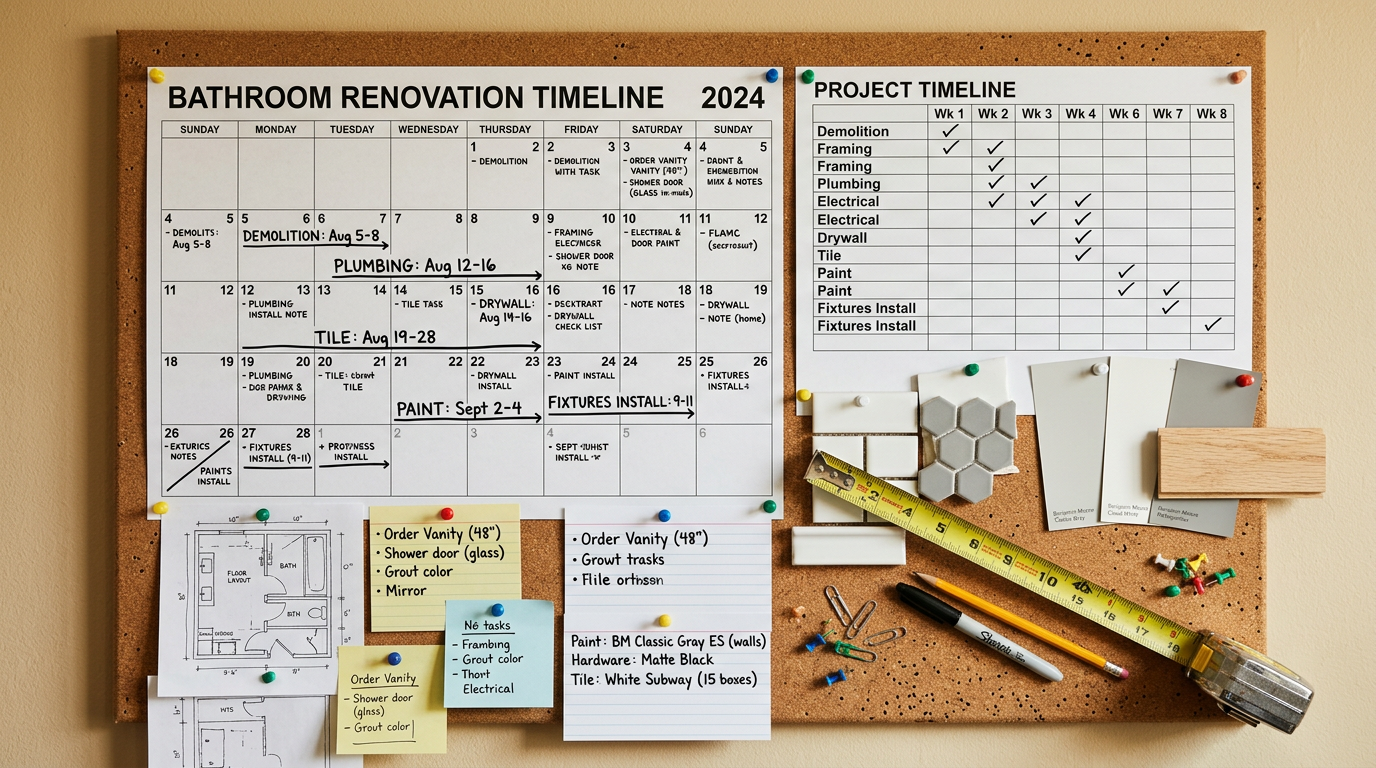
How Long Does a Bathroom Remodel Take? A Timeline Guide
Most bathroom remodels take 2 to 8 weeks of active construction, but the full project—from your first design meeting to the day you hang the towels—often runs 2 to 4 months when you account for planning, material procurement, and permitting. That gap between expectation and reality is where most homeowner frustration comes from.
This guide breaks down realistic timelines by project scope, walks through each construction phase day by day, and covers the most common causes of delays—and how to avoid them.
- Most bathroom remodels take 2–8 weeks of active construction, depending on scope
- Pre-construction planning, permitting, and material lead times add 4–8 weeks before demo begins
- A powder room or cosmetic refresh can wrap in 1–2 weeks; a master bath expansion runs 8–12+ weeks
- The single biggest cause of delays is making design decisions after demo has started
- Ordering all materials before demo begins can shave 1–3 weeks off your total timeline
Quick Answer: How Long Does a Bathroom Remodel Take?
For the majority of homeowners, the answer is 3 to 5 weeks of active construction for a standard full bathroom—think tile replacement, new fixtures, vanity swap, and updated lighting. Add 4 to 8 weeks of planning and procurement before demo starts, and you’re looking at roughly 2 to 3 months total from kickoff to completion.
The range widens significantly based on what you’re actually doing. A cosmetic refresh in a powder room is a different animal than moving walls to expand a master suite.
Bathroom Remodel Timeline by Project Type
| Project Type | Scope | Active Construction |
|---|---|---|
| Powder room / half bath | Vanity, toilet, fixtures, paint | 1–2 weeks |
| Small full bath (cosmetic) | Fixtures, vanity, tile refresh, no layout changes | 2–3 weeks |
| Standard full bath (mid-range) | Full tile, new fixtures, new vanity, no layout changes | 3–5 weeks |
| Master bath (full remodel) | Full tile, custom features, possible layout tweaks | 5–8 weeks |
| Luxury / addition / expansion | Layout changes, added square footage, high-end custom work | 8–12+ weeks |
These are active construction windows—boots on the ground, tools in the bathroom. They do not include the planning phase that happens before demo day.
The Pre-Construction Phase: 4–8 Weeks Before Demo
This is the phase most homeowners fail to budget time for, and it’s where projects most commonly fall behind before they even start.
Design and selections (2–5 weeks). You need to choose tile, fixtures, vanity, hardware, lighting, and any layout changes before your contractor can build a detailed scope of work and order materials. Homeowners who take their time on selections—or who change their minds midway—stretch this phase considerably.
Permitting (1–3 weeks, sometimes longer). Any project involving plumbing relocation, electrical work, or structural changes requires permits. Municipal review times vary widely. Some jurisdictions turn permits around in a few days; others take three to four weeks. Your contractor should pull permits—budget the time.
Material procurement (2–6 weeks). Custom tile, specialty fixtures, semi-custom vanities, and frameless glass enclosures are frequently backordered 4 to 10 weeks. Lead times on imported tile and custom cabinetry can stretch to 12 weeks or more. This is the most underestimated variable in bathroom remodel timelines.
Phase-by-Phase Construction Timeline
Once construction begins, here’s what each phase typically takes for a standard full bathroom remodel.
Demolition: 1–3 Days
Demo is the fastest phase and often the most satisfying to watch. The crew removes existing tile, flooring, vanity, toilet, tub or shower, and any drywall that needs to go. On a standard full bath, this is a 1-day job. If the bathroom is large or has a complex tile layout, it runs to 2 days. Factor in an extra day if asbestos testing is required on older homes.
Rough-In Plumbing and Electrical: 2–4 Days
After demo, the plumber and electrician do their rough-in work—moving or adding supply and drain lines, running new circuits, installing in-wall blocking for future fixtures. This phase must be completed and inspected before any walls close up.
If the layout isn’t changing and the existing rough-in is serviceable, rough-in can be as fast as 1 to 2 days. Moving a toilet, relocating a shower drain, or adding a dedicated circuit for a steam unit adds time. Expect 2 to 4 days for a project with meaningful scope.
Inspection scheduling is a wildcard. In some markets, inspectors come same-day or next-day. In others, you wait 3 to 5 business days for the rough-in inspection. Your contractor should know local inspection timelines and schedule accordingly.
Waterproofing and Cement Board / Drywall: 2–3 Days
Shower walls and wet areas require cement board or another approved substrate and a waterproofing membrane. The waterproofing membrane must cure—typically 24 to 48 hours—before tile begins. This is a non-negotiable wait that many timelines fail to account for. Rush it and you risk moisture intrusion behind your tile.
Moisture-resistant drywall goes up throughout the rest of the space during this phase as well.
Tile Installation: 3–7 Days
Tile is the most labor-intensive and variable phase. A simple floor-to-ceiling subway tile shower with basic floor tile wraps in 3 to 4 days. A large-format porcelain shower with a custom niche, decorative mosaic border, heated floor mud bed, and herringbone pattern floor can run 6 to 7 days or longer.
Factor in:
- Grout cure time: Grout typically needs 24 to 72 hours before it can get wet. Your contractor should include this in the schedule.
- Large-format tile: 24x48 slabs require more precision, more waste cutting, and more time per square foot than standard 4x16 subway.
- Custom patterns: Herringbone, chevron, and diagonal layouts take significantly longer to set than straight stack or offset brick.
Vanity, Toilet, and Fixture Installation: 1–2 Days
Once tile is complete, the finish work comes together quickly. The vanity and cabinet go in, followed by the toilet, shower valve trim, tub faucet, and sink. A licensed plumber handles the final connections—supply lines, drain connections, and pressure testing.
This is also when the electrician returns to install light fixtures, exhaust fans, GFCI outlets, and any heated floor thermostats.
Paint and Finish Carpentry: 2–3 Days
Paint goes on after tile and before hardware installation. Two coats of a quality bathroom paint, with dry time between coats, takes 1 to 2 days. Finish carpentry—baseboards, door casing, any built-in shelving or niche framing trim—adds another day.
Final Connections and Punch List: 1 Day
The last day covers mirror and accessory installation (towel bars, toilet paper holder, hooks), glass enclosure installation if the frame was set earlier, final caulking, and a contractor walkthrough. A thorough punch list review at this stage prevents callbacks and ensures everything is truly done.
Total active construction: 12–23 days for a standard full bathroom. Round to 3 to 5 weeks accounting for inspection holds, material deliveries, and typical crew scheduling gaps between trades.
Common Causes of Bathroom Remodel Delays
Even well-planned projects hit snags. These are the most frequent sources of timeline overruns.
Material Backorders
Tile and fixtures are the top culprits. A specific tile discontinues between when you select it and when your contractor orders it. A vanity ships damaged and a replacement is 6 weeks out. A frameless glass company has a 4-week fabrication lead time that nobody mentioned at the showroom.
The fix: confirm availability and lead times at purchase, not at ordering. Pay deposits to hold materials before demo begins.
Hidden Damage
Demo reveals what years of water exposure have done behind your walls. Subfloor rot under the toilet, mold in the shower wall framing, galvanized pipes that need full replacement—these discoveries are common, especially in bathrooms that are 20 to 30 years old and have had chronic leaks. Budget both time (3 to 7 additional days for rot repair and remediation) and money for contingencies.
Permit and Inspection Delays
Permit review backlogs and inspection scheduling windows are outside your contractor’s control. In high-growth markets, permit review can take 3 to 5 weeks. Inspection scheduling—especially for rough-in and final—can add multiple days of idle time to the job.
Your contractor should apply for permits immediately after signing the contract, not after demo. That lead time matters.
Contractor Scheduling Gaps
Most bathroom remodels use multiple subcontractors: plumber, electrician, tile setter, glass company. Each sub has their own schedule. If the plumber finishes rough-in on Friday but the tile setter can’t start until the following Wednesday, that’s a 3-day gap in active work. Multiply this across several trades and you can add a week or more to your timeline.
A general contractor who manages their own subcontractor relationships—and keeps them moving—is worth their markup. See our guide to bathroom remodel order of operations for more on trade sequencing.
Change Orders After Demo
This is the most controllable cause of delays. Once walls are open and the job is in motion, changing your tile selection or adding a niche that wasn’t in the original scope creates a cascading set of problems: new materials to order, new scheduling, revised subcontractor scope. A single change order mid-project can add 1 to 3 weeks.
How to Speed Up Your Bathroom Remodel
You cannot compress a properly executed remodel indefinitely—waterproofing has to cure, grout has to set, inspections have to happen. But you can eliminate the avoidable delays.
Finalize all selections before demo. Tile, vanity, fixtures, mirrors, hardware, lighting—every single thing. Walk through the bathroom with your contractor and confirm what goes where before a single tile is removed.
Order materials early and confirm delivery dates. Pay deposits to hold your tile and vanity. Get written confirmation of lead times. If something is backordered 8 weeks, you need to know before demo day, not after.
Hire a contractor who manages their own subs. A GC with established subcontractor relationships can coordinate trade scheduling to minimize gaps. Ask prospective contractors how they handle trade sequencing and what their typical crew schedule looks like.
Avoid mid-project changes. Every change order has a time cost, not just a dollar cost. Make every decision before work begins.
Have your space prepared on demo day. Clear the bathroom completely, shut off water and power in advance if possible, and ensure site access is unobstructed. A prepared job site loses less time on day one.
Pre-Demo Checklist to Prevent Delays
- All tile selections finalized, deposits paid, lead times confirmed in writing
- Vanity and countertop ordered and delivery date confirmed
- All plumbing fixtures (toilet, faucets, shower valve) selected and ordered
- Lighting and exhaust fan selected and ordered
- Mirror and accessories selected
- Shower glass company measured and order placed (4–6 week lead time is common)
- Permits applied for (not just planned—actually submitted)
- Written project schedule from contractor with trade sequencing
- Asbestos/lead test completed if home was built before 1980
- Temporary bathroom arrangements confirmed for the duration of the project
Realistic Total Timeline: From First Call to Final Walkthrough
Putting it all together for a standard full bathroom remodel:
| Phase | Duration |
|---|---|
| Design, selections, contractor vetting | 3–5 weeks |
| Permitting (overlaps with procurement) | 1–3 weeks |
| Material procurement | 2–6 weeks |
| Active construction | 3–5 weeks |
| Total elapsed time | 8–16 weeks |
For a master bath with significant scope—layout changes, custom tile, premium fixtures, steam shower—run the top of that range: 4 to 5 months from first meeting to final walkthrough is realistic.
For a budget is also a key part of planning. See our breakdown of how much a bathroom remodel costs to set realistic financial expectations alongside your timeline.
And if you want to avoid the mistakes that stretch projects past their deadlines, our guide to bathroom remodel mistakes to avoid covers the most common homeowner errors in detail.
Bottom Line
A bathroom remodel takes 3 to 5 weeks of active construction for most standard projects, but the full timeline from first design conversation to final walkthrough is closer to 2 to 4 months. The gap is almost entirely pre-construction: selections, permitting, and material lead times.
The homeowners who finish on time are the ones who make all their decisions before demo day, order materials with lead time to spare, and hire a contractor who sequences trades tightly. The ones who run over are the ones who start demo before they’ve picked their tile.
Plan first. Demo second.
Deep Dive: More on Bathroom Remodel
10 Bathroom Tile Trends for 2026: What's In and What's Out
The top bathroom tile trends for 2026 — from zellige to tile drenching. See what's trending, what it costs, and which styles have staying power.
How to Choose a Bathroom Vanity: Sizes, Styles, and What to Look For
A complete guide to choosing the right bathroom vanity. Covers sizes, materials, countertops, sinks, and costs for every budget.
Do You Need a Permit for a Bathroom Remodel? Here's When It's Required
Find out which bathroom remodel projects need permits and which don't. Covers costs, process, and what happens if you skip them.
Best Tile for Bathroom Floors: A Complete Comparison Guide
Choosing bathroom floor tile? Compare porcelain, ceramic, natural stone, and vinyl by cost, durability, water resistance, and maintenance.