
Do You Need a Permit for a Bathroom Remodel? Here's When It's Required
- Cosmetic work — painting, fixture swaps, hardware — never requires a permit
- Plumbing moves, new electrical circuits, and structural changes almost always require a permit
- Permit fees typically range from $200 to $2,000 depending on project scope and municipality
- Unpermitted work can void homeowner's insurance, trigger fines, and create serious problems at resale
- Either you or your licensed contractor can pull the permit — most pros handle it as part of the job
- Requirements vary significantly by city and county — always verify with your local building department
Whether you need a permit for a bathroom remodel is one of the most common questions homeowners ask before starting a project — and the answer depends on what work you’re actually doing. Get it right and your project passes inspections, your insurance stays intact, and your home sells without complications. Get it wrong and you could be forced to tear out finished work, pay fines, or disclose unpermitted construction to future buyers.
This guide explains exactly which bathroom remodel work triggers permit requirements, what the process looks like, what it costs, and what’s at stake if you skip it.
What Work Requires a Permit for a Bathroom Remodel?
The general rule is straightforward: any work that affects health, safety, or structural integrity requires a permit. For bathrooms, that breaks down across three trades.
Plumbing Permits
Plumbing permits are the most commonly required permit in bathroom remodels. You’ll need one whenever work goes beyond swapping a faucet:
- Relocating any plumbing fixture: Moving a toilet, shower, bathtub, or sink to a new position requires permits and rough-in inspections
- Adding new plumbing: Installing a second sink, a new shower, or a wet bar in a bathroom addition
- Replacing supply or drain lines: Repiping sections of supply lines or extending drain lines
- Installing a new water heater in a bathroom addition
- Shower valve replacement that involves opening the wall (varies by municipality)
Simply swapping a faucet, replacing a showerhead, or installing a new toilet in the same drain location typically does not require a plumbing permit — but verify locally.
Electrical Permits
Bathrooms are classified as wet locations under the National Electrical Code, which means electrical work is scrutinized closely. A permit is required for:
- Adding or moving outlets: Any new GFCI outlet installation
- New circuits: Adding a dedicated circuit for a whirlpool tub, heated floor, or bathroom addition
- Exhaust fan installation or relocation: Running new wiring for a ventilation fan
- Lighting changes that require new wiring: Adding recessed lights or moving junction boxes
- Installing an electric radiant floor heating system
Replacing a light fixture with the same type and same wiring connection typically does not need a permit. Changing out an exhaust fan for the same size unit at the same location is also typically exempt in most jurisdictions.
Structural and General Building Permits
- Moving, removing, or adding walls: Any wall work, particularly if load-bearing
- Enlarging the bathroom footprint: Bumping out walls, converting a closet into bathroom space
- Window or door additions: Cutting a new window opening or widening a doorway
- Subfloor repairs over a certain square footage (threshold varies by municipality)
- Converting a half-bath to a full bath: Typically requires permits for both plumbing and general construction
What Doesn’t Require a Permit
Cosmetic and like-for-like replacements are generally permit-exempt everywhere. The following work almost never requires a permit:
- Painting walls, ceiling, or trim
- Replacing a toilet with another toilet in the same drain location
- Swapping a faucet, showerhead, or towel bar
- Installing a new vanity mirror or medicine cabinet (no new wiring)
- Replacing a vanity cabinet without altering plumbing connections
- Installing new flooring over existing subfloor (tile, vinyl, or luxury vinyl plank)
- Re-caulking a tub or shower
- Replacing a light fixture using the existing wiring and junction box
- Reglazing or refinishing a tub
The key principle: if you’re not touching the rough-in (the pipes, wires, and structure hidden in the walls), you generally don’t need a permit.
Permit vs. No Permit: Quick Reference
| Bathroom Work | Permit Required? |
|---|---|
| Paint, hardware, mirrors | No |
| New toilet (same drain location) | No |
| Faucet / showerhead swap | No |
| New vanity (same plumbing location) | No |
| Tile replacement (no subfloor work) | No |
| Light fixture replacement (same wiring) | No |
| Exhaust fan replacement (same location, no new wiring) | Usually no |
| Move toilet to new location | Yes |
| Add second sink or shower | Yes |
| Relocate plumbing supply or drain lines | Yes |
| Add new electrical circuit | Yes |
| Install GFCI outlet where none existed | Yes |
| Run new wiring for exhaust fan or lighting | Yes |
| Remove or add a wall | Yes |
| Expand bathroom square footage | Yes |
| Convert half-bath to full bath | Yes |
| Install radiant floor heating (electric) | Yes |
Regional Variation: Why Requirements Differ
There is no single national standard for bathroom remodel permits. The United States has approximately 19,000 local jurisdictions — each with its own building code adoption schedule and local amendments.
What this means in practice:
- Some cities require a permit for any plumbing work, including a toilet swap; others only require one for rough-in changes
- Exhaust fan wiring rules vary: Some jurisdictions treat fan-only wiring runs as permit-required, others don’t
- Tile over subfloor thresholds differ: One city may require a permit for subfloor repairs over 50 square feet; another sets the threshold at 100 square feet
- Historic districts often layer additional review requirements on top of standard permit requirements
States like California and New York tend to have stricter enforcement and higher permit fees. Rural municipalities may have more relaxed requirements or limited inspection capacity. Never assume your neighbor’s experience in another city applies to your project.
How to Get a Building Permit for a Bathroom Remodel
Step 1: Prepare Your Documentation
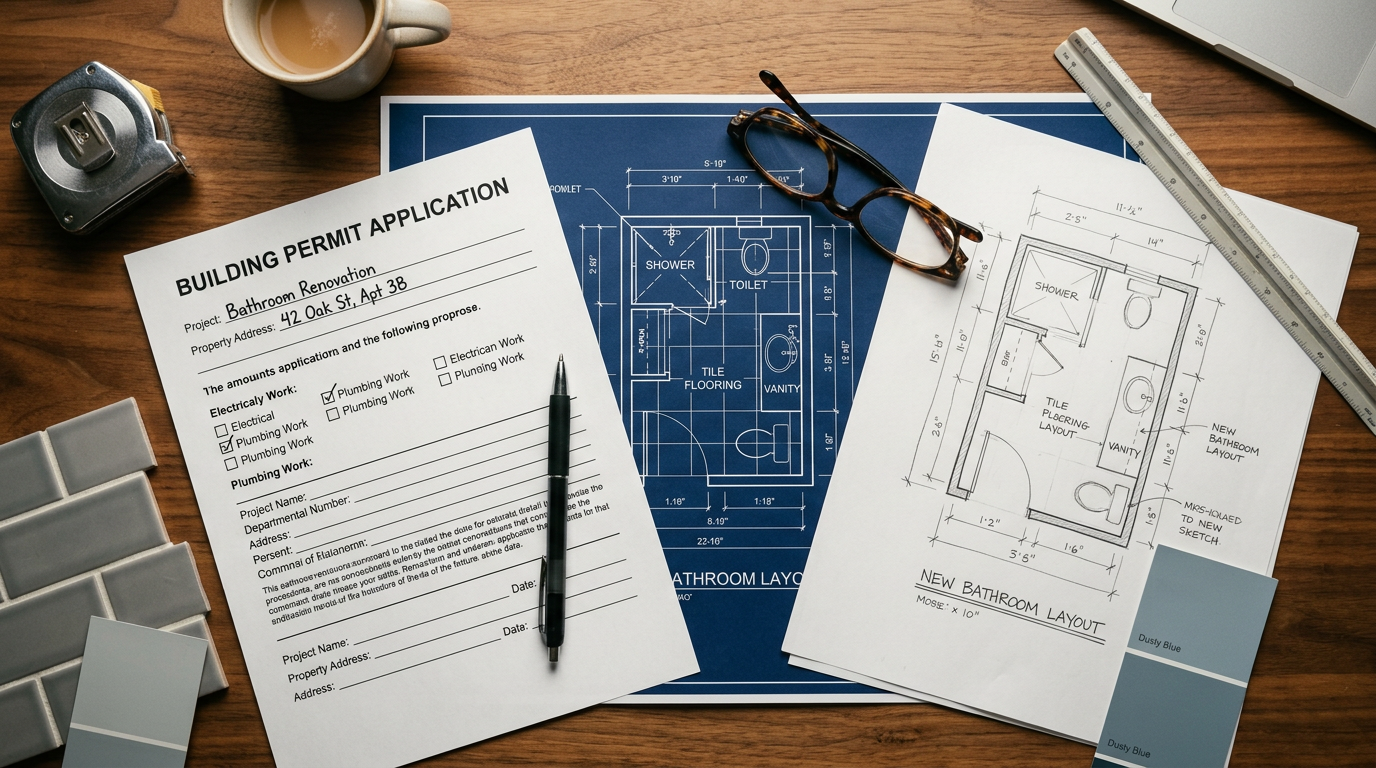
Most building departments require plans for permitted work. For a standard bathroom remodel, you’ll typically need:
- A simple floor plan showing existing and proposed layout (drawn to scale)
- Plumbing diagram if moving or adding fixtures
- Electrical plan if adding circuits or outlets
- Product specifications for fixtures and materials (sometimes required for mechanical permits)
For complex projects, you may need drawings stamped by a licensed architect or engineer. For most residential bathroom remodels, homeowner-drawn plans are sufficient.
- Completed permit application form (available online or at the building department)
- Proof of property ownership or authorization from the owner
- Floor plan showing current bathroom layout and proposed changes
- Plumbing diagram if relocating or adding fixtures
- Electrical plan if adding circuits, outlets, or running new wiring
- Contractor license number and insurance certificate (if a contractor is pulling the permit)
- Payment for permit fees (varies by scope and jurisdiction)
- Site address and parcel/tax ID number
Step 2: Submit the Application
Most building departments now accept online applications through their permitting portals. You can also submit in person. Many jurisdictions allow over-the-counter permits for standard residential bathroom work — meaning you get the permit the same day.
For larger projects or jurisdictions with high volume, plan review can take anywhere from a few days to several weeks.
Step 3: Schedule Inspections
Permits aren’t just paperwork — they come with required inspections at specific project milestones. For a bathroom remodel, you’ll typically face:
- Rough-in inspection: After plumbing, electrical, and any framing work is done but before the walls are closed. This is the most critical inspection — an inspector verifies the plumbing drain and supply work, electrical rough-in, and structural elements meet code.
- Final inspection: After all work is complete, fixtures are installed, and the bathroom is operational. The inspector confirms everything matches the approved plans and the work is safe.
Some projects require additional inspections (waterproofing, framing, insulation). Your permit documents will specify the required inspection sequence.
How Much Does a Bathroom Remodel Permit Cost?
Permit fees are calculated differently by jurisdiction. Common methods include:
- Flat rate per trade permit: Many cities charge separate fees for building, plumbing, and electrical permits — each ranging from $75 to $500
- Percentage of project value: Some jurisdictions charge 0.5–2% of the estimated construction cost
- Square footage basis: A per-square-foot fee applied to the renovation area
For a typical mid-range bathroom remodel, expect total permit fees to fall in the $200–$2,000 range. High-cost metro areas (New York, San Francisco, Seattle) are consistently at the upper end. In smaller cities and rural areas, fees can be well under $500 for the same scope of work.
Permit fees are a minor fraction of a total bathroom remodel budget — see our full bathroom remodel cost breakdown for where the bulk of the budget actually goes.
Who Pulls the Permit: Contractor vs. Homeowner?
Both options are legitimate — but each has tradeoffs.
Licensed Contractor Pulls the Permit
This is the default for most projects. When a contractor pulls the permit:
- The contractor’s license number is on record, and they bear responsibility for code compliance
- It’s generally faster since established contractors have existing relationships with local building departments
- Any code violations discovered during inspection are the contractor’s problem to remedy
- The contractor schedules and coordinates inspections as part of project management
Ask any contractor you hire directly: “Will you pull all required permits for this project?” A contractor who hesitates or suggests skipping permits is a significant red flag. See our guide on bathroom remodel mistakes to avoid — hiring unlicensed or permit-skipping contractors is near the top of that list.
Homeowner Pulls the Permit
In most states, a homeowner can pull permits for work on their own primary residence as an owner-builder. This is common when:
- You’re doing significant portions of the work yourself
- You’re acting as your own general contractor and hiring individual subcontractors
- Your contractor prefers the homeowner to hold the permit (less common, and worth understanding why)
What Happens If You Skip the Permit?
Skipping a permit might feel like it saves time and money upfront. The consequences range from annoying to catastrophic.
Insurance Complications
Your homeowner’s insurance policy likely requires that improvements to your home comply with local building codes. If a plumbing failure or electrical fire occurs in an area where unpermitted work was done, your insurer has grounds to deny the claim. This isn’t a theoretical risk — it’s a documented basis for claim denial.
Resale Problems
Real estate transactions increasingly involve detailed permit history reviews. Problems that arise at resale:
- Mandatory disclosure: In most states, sellers must disclose known unpermitted work to buyers
- Buyer demands: A buyer’s inspector who flags unpermitted work gives the buyer negotiating leverage — price reductions, repair credits, or backing out entirely
- Lender requirements: Some lenders will not approve financing on homes with significant unpermitted work
- Title issues: Unpermitted additions can create title complications in some jurisdictions
Fines and Forced Remediation
If the unpermitted work is discovered while you own the home:
- Stop-work orders: If discovered mid-project, a municipality can issue a stop-work order halting all construction immediately
- After-the-fact permit fees: Most jurisdictions charge a penalty multiplier — often 2–3× the original permit fee — to legalize unpermitted work after the fact
- Mandatory demolition: In worst-case scenarios, a building department can require that unpermitted work be torn out so an inspector can verify what’s behind the walls, then rebuilt to code
The cost of a permit — a few hundred to a couple thousand dollars — is negligible compared to being forced to demo and rebuild finished tile work.
What Inspectors Actually Look For
Inspectors are not looking for reasons to fail your project. Their job is to verify that the work meets minimum safety codes. At a bathroom rough-in inspection, they typically check:
Plumbing:
- Correct drain slope (1/4 inch per foot for horizontal runs)
- Proper vent pipe installation
- Supply line pressure tested (no leaks)
- Correct pipe sizing for fixture load
Electrical:
- GFCI protection on all outlets within 6 feet of a water source
- Proper wire gauge for circuit loads
- Correct junction box installation
- Exhaust fan vented to the exterior (not into the attic)
Structural:
- Notching and boring of studs meets code tolerances
- Fire blocking in place where required
- Proper header sizing over new openings
At a final inspection, the inspector confirms fixtures are properly installed, the exhaust fan operates, outlets test correctly, and the finished work matches the approved plans.
Bottom Line
The permit question has a reliable answer for most bathroom remodel work: cosmetic updates and like-for-like replacements don’t require permits; plumbing moves, new electrical circuits, and structural changes do. The stakes for skipping required permits — insurance voidance, resale complications, potential fines and forced demolition — are far too high relative to the cost of doing it right.
Before your project starts, call your local building department to confirm requirements for your specific scope. And if you’re hiring a contractor, make “will you pull all required permits?” a non-negotiable requirement. A licensed professional who handles permits as a standard part of the job is the most reliable way to ensure your remodel is done correctly, legally, and without complications down the road.
Deep Dive: More on Bathroom Remodel
10 Bathroom Tile Trends for 2026: What's In and What's Out
The top bathroom tile trends for 2026 — from zellige to tile drenching. See what's trending, what it costs, and which styles have staying power.
How to Choose a Bathroom Vanity: Sizes, Styles, and What to Look For
A complete guide to choosing the right bathroom vanity. Covers sizes, materials, countertops, sinks, and costs for every budget.
How Long Does a Bathroom Remodel Take? A Timeline Guide
A bathroom remodel takes 2-8 weeks depending on scope. See phase-by-phase timelines, common delays, and how to keep your project on track.
Best Tile for Bathroom Floors: A Complete Comparison Guide
Choosing bathroom floor tile? Compare porcelain, ceramic, natural stone, and vinyl by cost, durability, water resistance, and maintenance.