
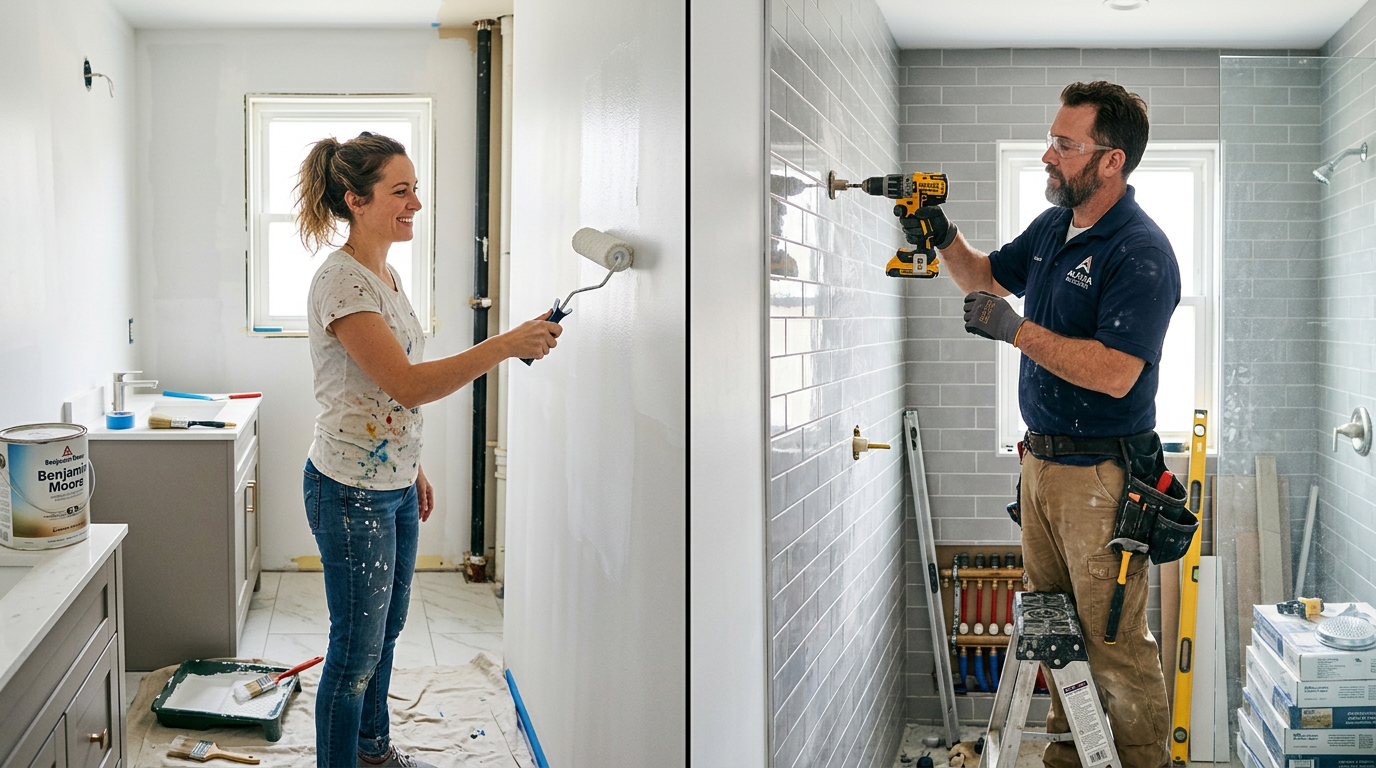
DIY Bathroom Remodel vs. Hiring a Contractor: An Honest Comparison
- DIY bathroom remodeling saves 40–60% on labor costs, but mistakes in plumbing, electrical, or waterproofing often cost more to fix than hiring a pro would have
- Cosmetic work — painting, hardware, vanity swaps, mirrors, and basic flooring — is genuinely DIY-friendly for most homeowners
- Plumbing rough-in, electrical circuits, shower waterproofing, and structural changes should always be handled by licensed professionals
- DIY timelines typically run 2–4 months of weekends vs. 3–6 weeks for a contractor — factor in living without your bathroom
- A hybrid approach (DIY cosmetics, hire pros for plumbing and tile) often delivers the best cost-to-quality ratio
The internet is full of bathroom remodel before-and-afters that make DIY look effortless. In reality, the decision between doing it yourself and hiring a contractor involves real trade-offs — money, time, quality, and risk. This guide gives you an honest look at both sides so you can make the right call for your specific project.
The Core Cost Difference
Labor accounts for 40–60% of a typical bathroom remodel. That’s the source of the often-cited “DIY saves you half” claim — and it’s largely true, with important caveats.
For a mid-range bathroom remodel budgeted at $18,000 with a contractor, the labor portion alone might be $8,000–$10,000. DIYing that same project could bring total costs down to $9,000–$11,000 in materials and rental equipment.
Here’s where the math gets complicated:
| Cost Factor | DIY | Hiring a Contractor |
|---|---|---|
| Labor | $0 (your time) | $7,000–$12,000 |
| Materials | $7,000–$10,000 | $7,000–$10,000 |
| Tool/equipment rental | $300–$800 | $0 (included) |
| Permit fees (if pulled) | $500–$2,000 | $500–$2,000 |
| Mistake corrections | Highly variable | Typically covered by warranty |
| Total (mid-range project) | $8,000–$13,000 | $15,000–$24,000 |
The savings are real. The risk is also real. A plumbing connection done wrong, a shower pan that isn’t properly waterproofed, or a missing GFCI outlet can cost $2,000–$8,000 to remediate — sometimes more if water damage has spread behind walls.
Real Cost Scenarios
Scenario A — Full DIY (ambitious homeowner): A homeowner in Columbus, OH tackles a complete hall bath refresh. They paint, install a new vanity, replace the toilet, swap hardware, and lay peel-and-stick vinyl plank flooring. Total spend: $2,400 in materials over six weekends. Result: clean, functional, no issues. This is the DIY success story.
Scenario B — DIY overstep: A homeowner in Phoenix attempts to retile the shower and move the showerhead location. Tile work goes well. The new plumbing connection leaks slowly behind the wall. Mold discovered 14 months later. Remediation plus redo: $6,200. Total cost: $9,100 — more than a contractor would have charged.
Scenario C — Hybrid approach: A homeowner in Charlotte hires a plumber and tile setter for the shower and tub surround ($4,800), then DIYs the painting, vanity install, mirror, and accessories ($1,900 in materials). Total: $6,700. Professional-quality result where it matters most, real savings on the rest.
What You Can Safely DIY
Not all bathroom work carries equal risk. These tasks are genuinely accessible to homeowners with basic tools and patience:
- Painting walls, ceiling, and trim (use a moisture-resistant primer in wet areas)
- Replacing cabinet hardware, towel bars, toilet paper holders, and robe hooks
- Swapping out a vanity light fixture (turn off the circuit breaker first)
- Installing a new vanity and sink (if you're not moving the drain location)
- Replacing a toilet (straightforward with a wax ring replacement kit)
- Hanging a new mirror or medicine cabinet
- Installing floating shelves and bathroom storage
- Replacing a faucet on an existing sink
- Laying peel-and-stick vinyl plank or luxury vinyl tile over a solid subfloor
- Caulking around tub and sink edges (removing old caulk, applying new bead)
- Installing a new exhaust fan in the same location (same wiring and duct)
The common thread through all of these: they don’t require permits, don’t touch structural elements, and mistakes are either visible immediately or low-stakes to correct.
What You Should Never DIY
The following tasks have high failure rates for DIYers, carry permit requirements in most jurisdictions, or have failure consequences serious enough to warrant professional work in virtually every case:
Plumbing rough-in and drain relocation: Moving a drain or toilet requires cutting through concrete or modifying the drain stack. Done wrong, you get sewage backflow, chronic clogs, or slow leaks inside your floor structure. Licensed plumbers carry code knowledge and liability insurance for a reason.
Electrical circuits: Adding a new circuit for a heated floor, additional outlets, or a dedicated exhaust fan requires a permit and licensed electrical work in most states. GFCI protection in bathrooms isn’t optional — it’s code, and inspectors check it.
Shower pan waterproofing: This is the most consequential DIY failure point. A shower pan that isn’t properly waterproofed will leak — not immediately, but within 1–3 years, usually into the subfloor and into the room below. By the time you see damage, you’re often looking at subfloor replacement, drywall replacement, and mold remediation. The cost of doing it wrong routinely exceeds $5,000–$15,000.
Structural modifications: Removing walls, raising or lowering ceilings, enlarging the bathroom footprint — anything that touches load-bearing structure requires permits, engineering review in many cases, and licensed general contractor oversight.
Tile shower walls (wet area): Unlike floor tile, shower wall tile requires proper substrate (cement board or equivalent), correct setting materials rated for wet/immersed use, and precise technique for waterproof grout application. Cosmetic failures (cracked grout, loose tiles) are annoying; waterproofing failures are expensive.
Timeline: The Hidden DIY Cost
Money isn’t the only resource. A contractor working full-time can complete a mid-range bathroom remodel in 3–6 weeks. A DIY remodel done on weekends typically takes 2–4 months — and that’s assuming no major setbacks.
| Phase | Contractor Timeline | DIY Timeline |
|---|---|---|
| Demo and rough-in | 3–5 days | 2–3 weekends |
| Plumbing and electrical | 2–4 days | Hire out or 1–2 weekends |
| Cement board and waterproofing | 1–2 days | 1 weekend + cure time |
| Tile work | 3–7 days | 3–6 weekends |
| Vanity, fixtures, finishing | 2–4 days | 2–3 weekends |
| Paint and accessories | 1–2 days | 1–2 weekends |
| Total | 3–6 weeks | 2–4 months |
During that entire DIY period, you’re living without a functioning bathroom — or at reduced functionality. For households with one bathroom, this calculation alone often tips the decision toward hiring a contractor.
Permit Complications for DIY Work
Permits exist to protect you. For bathroom remodels involving plumbing or electrical work, permits are required in virtually every U.S. jurisdiction. For DIYers, this creates a practical problem: most municipalities allow homeowners to pull their own permits, but inspectors will scrutinize owner-performed work more carefully, and some jurisdictions require licensed-contractor signatures on certain permit types.
What happens if you skip permits on DIY work:
- Homeowner’s insurance: Damage from unpermitted work is commonly excluded from coverage. A plumbing leak from unpermitted work may not be covered.
- Sale disclosure: In most states, you’re legally required to disclose unpermitted work when selling. Buyers’ inspectors flag this, and buyers either walk or demand price reductions.
- Remediation requirement: If a future inspection catches unpermitted work, you may be required to open walls and redo everything to current code — at your expense.
For a full discussion of what triggers permit requirements in bathroom remodels, see our guide on whether you need a permit for a bathroom remodel.
Quality and Warranty Implications
A licensed contractor’s work typically comes with a workmanship warranty — commonly 1–2 years, sometimes longer for specific work like waterproofing. If a contractor’s tile work cracks or a plumbing connection leaks, you have legal recourse.
DIY work has no warranty. If your tile work fails, you’re doing it again at full material cost and your own labor. The quality gap also varies dramatically by task:
| Task | DIY Quality Ceiling | Contractor Quality |
|---|---|---|
| Painting | High (with prep work) | High |
| Tile installation | Medium (steep learning curve) | High |
| Plumbing connections | Low–Medium | High + code compliant |
| Waterproofing | Low (hard to verify) | High + warranty |
| Vanity install | High | High |
| Grout and caulk finish | Medium | High |
The tasks where contractor quality genuinely exceeds DIY quality by a wide margin are also the tasks that carry the biggest failure risk.
Resale Value Impact
A bathroom remodel returns 60–67% of cost at resale on average, according to Remodeling Magazine’s 2025 Cost vs. Value report. But that number assumes professional-quality work.
A DIY remodel with visible imperfections — uneven tile lines, caulk that’s already separating, a vanity that’s slightly out of level — can actually hurt resale value. Buyers who see evidence of amateur work begin to wonder what they can’t see. Home inspectors are specifically trained to identify DIY plumbing and electrical work.
Cosmetic DIY work (painting, hardware, accessories) typically doesn’t register negatively at resale because the quality ceiling for those tasks is genuinely achievable by most homeowners.
The Hybrid Approach: Often the Best Answer
For most homeowners, the smartest strategy is neither fully DIY nor fully contracted — it’s a deliberate split:
Hire professionals for:
- All plumbing work (rough-in, fixture connections, drain modifications)
- Electrical circuits and GFCI installation
- Shower waterproofing and tile installation in wet areas
- Floor tile installation if using natural stone or large-format tile
DIY the rest:
- Painting (walls, ceiling, trim)
- Vanity installation (if drain location doesn’t change)
- Hardware, accessories, mirrors
- Peel-and-stick vinyl flooring in dry areas
- Caulking and final touch-ups
This approach typically saves $3,000–$6,000 compared to full-contractor pricing while concentrating professional work on the high-risk tasks. You’re not betting your subfloor on your ability to learn shower pan technique from YouTube.
For a look at how the full sequence of a bathroom remodel unfolds and where DIY work fits in, see our guide on bathroom remodel order of operations.
When to Hire a Contractor
Hire a licensed contractor if any of the following are true:
- Your remodel involves moving plumbing lines or changing the drain location
- You’re retiling the shower or building a new shower enclosure
- You’re adding a bathroom or expanding the existing footprint
- You have only one bathroom and can’t afford months of limited access
- Your project requires permits for electrical or plumbing work
- You’re planning to sell within 3–5 years and need documented, permitted work
- You’ve never laid tile, and the shower is your planned first project
Insurance and Liability
One factor that rarely gets discussed: if a contractor’s employee is injured on your property during a project, their contractor’s general liability and workers’ compensation insurance covers it. If you’re doing DIY work and get hurt, you’re covered only by your own health insurance.
More practically, if your DIY plumbing work causes water damage to a neighbor’s property (a condo situation, for example), your homeowner’s insurance may deny the claim on the basis of unpermitted work. The liability exposure is real.
Our Recommendation
Go full DIY if: Your project is cosmetic — painting, hardware, accessories, a vanity swap, maybe luxury vinyl flooring. These tasks have a high quality ceiling for DIYers, zero permit complications, and genuine savings of $500–$2,000 in labor.
Go hybrid if: You want to do a meaningful remodel but aren’t willing to gamble on waterproofing and plumbing. Hire licensed tradespeople for those specific scopes, then handle the painting and finishing yourself. This is the approach that delivers the best combined outcome for most homeowners.
Go full contractor if: Your remodel involves any plumbing relocation, new shower construction, structural changes, or if you have one bathroom and need it back in weeks rather than months. The savings from DIYing high-risk tasks rarely justify the downside.
The 40–60% labor savings that DIY promises is real — but it’s real on the tasks where DIY is appropriate. On plumbing, electrical, and waterproofing, the expected cost of mistakes erases that savings and then some.
For a realistic picture of what professional bathroom remodel costs look like in your area, see our detailed bathroom remodel cost guide.
Deep Dive: More on Bathroom Remodel
10 Bathroom Tile Trends for 2026: What's In and What's Out
The top bathroom tile trends for 2026 — from zellige to tile drenching. See what's trending, what it costs, and which styles have staying power.
How to Choose a Bathroom Vanity: Sizes, Styles, and What to Look For
A complete guide to choosing the right bathroom vanity. Covers sizes, materials, countertops, sinks, and costs for every budget.
How Long Does a Bathroom Remodel Take? A Timeline Guide
A bathroom remodel takes 2-8 weeks depending on scope. See phase-by-phase timelines, common delays, and how to keep your project on track.
Best Tile for Bathroom Floors: A Complete Comparison Guide
Choosing bathroom floor tile? Compare porcelain, ceramic, natural stone, and vinyl by cost, durability, water resistance, and maintenance.