
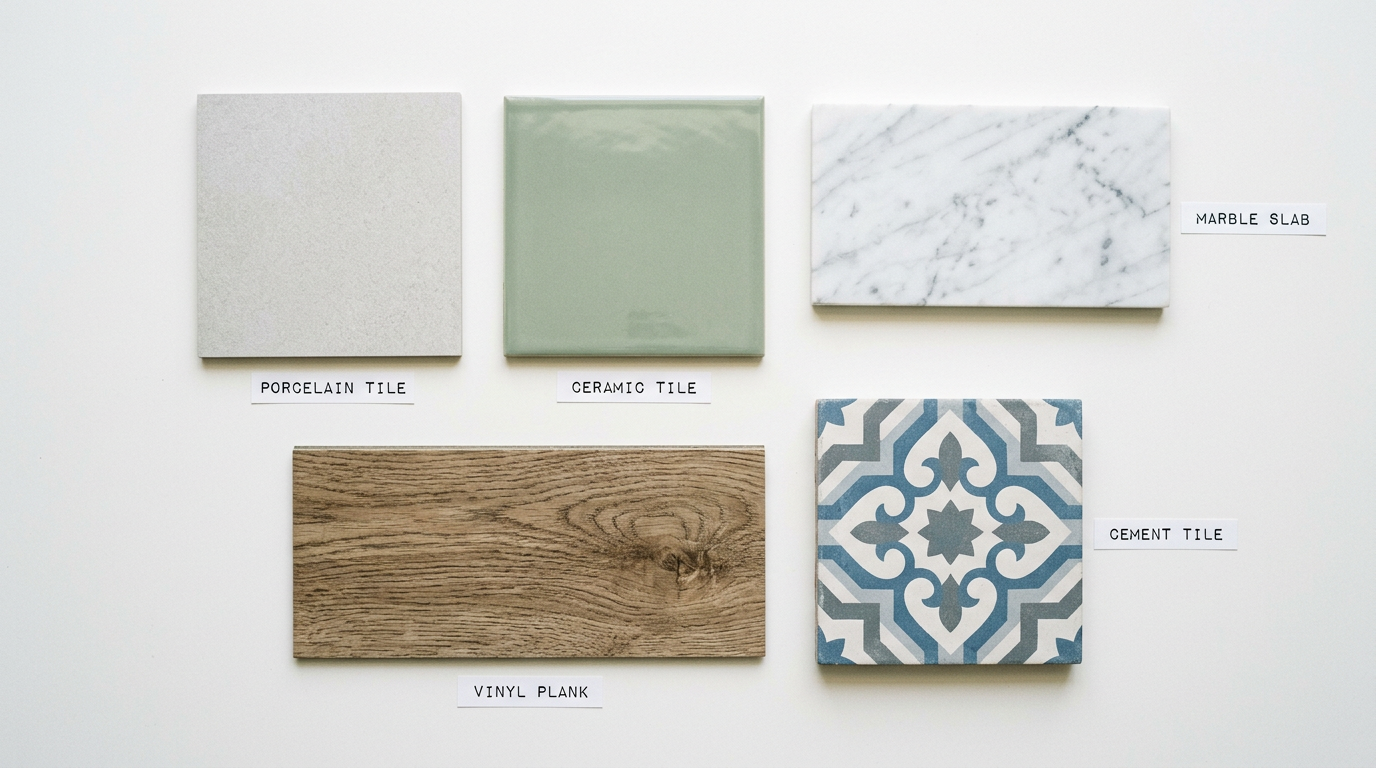
Best Tile for Bathroom Floors: A Complete Comparison Guide
- Porcelain is the best all-around choice for bathroom floors — water absorption under 0.5%, 50+ year lifespan, and available at every price point
- Ceramic costs less than porcelain and is easier to cut, making it ideal for budget-conscious remodels in low-traffic bathrooms
- Natural stone looks premium but requires annual sealing and costs $5–$50/sqft — it's a maintenance commitment, not just a material choice
- Look for a DCOF (Dynamic Coefficient of Friction) rating of 0.42 or higher for wet floor safety
- Large-format tiles (12×24 or bigger) make small bathrooms feel larger by reducing grout lines
- Heated floor compatibility varies by material — porcelain, ceramic, and LVP work well; natural stone retains heat the best
How to Choose Bathroom Floor Tile: What Actually Matters
The right tile for your bathroom floor depends on four things: how much water exposure the floor sees, how much foot traffic it takes, your maintenance tolerance, and your budget. Everything else — color, pattern, size — is preference.
This guide covers every major tile type with honest pros, cons, and costs. We’ll also address the porcelain vs. ceramic debate in detail, since it’s the most common question homeowners face when shopping.
All Tile Types Compared: At a Glance
| Material | Cost (material only) | Water Resistance | Durability | Maintenance | Best For |
|---|---|---|---|---|---|
| Porcelain | $3–$15/sqft | Excellent (≤0.5% absorption) | 50+ years | Low | Most bathrooms — best overall |
| Ceramic | $1–$10/sqft | Good (≤3% absorption) | 20–30 years | Low | Budget remodels, low-traffic baths |
| Natural Stone (marble) | $10–$50/sqft | Poor (unsealed) | 50+ years | High | Luxury master baths |
| Natural Stone (travertine) | $5–$30/sqft | Poor (unsealed) | 50+ years | High | Spa-style bathrooms |
| Natural Stone (slate) | $5–$20/sqft | Moderate | 50+ years | Moderate | Rustic and contemporary styles |
| Vinyl / LVP | $2–$7/sqft installed | Excellent (waterproof) | 15–25 years | Very Low | Rentals, DIY installs, budget baths |
| Cement tile | $8–$20/sqft | Poor (unsealed) | 20–30 years | High | Accent areas, design-forward spaces |
Installed costs add $5–$15/sqft for labor depending on tile complexity, subfloor prep, and your region.
Porcelain Tile: Best Overall
Porcelain tile is made from dense, refined clay fired at higher temperatures than ceramic. The result is a harder, less porous tile that handles everything a bathroom can throw at it.
Water absorption rate: Less than 0.5% — effectively impervious to moisture.
Cost: $3–$15/sqft for material. Budget porcelain starts around $3–$5/sqft; large-format or designer porcelain runs $10–$15/sqft. Installed cost is typically $8–$22/sqft.
Lifespan: 50 years or more with basic maintenance.
Pros
- Lowest water absorption of any tile — the correct choice for shower floors, wet rooms, and full family baths
- Extremely hard and scratch-resistant (PEI rating 4–5 for floor-grade porcelain)
- Available in nearly every size, finish, and style including convincing wood and stone looks
- Frost-resistant, making it suitable for bathrooms in cold climates
- Low ongoing maintenance — no sealing required
Cons
- Harder to cut than ceramic — requires a wet saw with a diamond blade; more brittle during installation
- Heavier than ceramic, which matters if the subfloor needs reinforcement
- Premium designs cost significantly more than ceramic equivalents
Best Use Case
Any bathroom. Porcelain is particularly well-suited to high-humidity master baths, kids’ bathrooms with wet floors, and any shower floor application.
Ceramic Tile: Best for Budgets
Ceramic tile is made from natural clay fired at lower temperatures than porcelain. It’s more porous, slightly less dense, but also more affordable and easier to work with.
Water absorption rate: Up to 3% — fine for bathroom floors that dry quickly, but not ideal for shower floors.
Cost: $1–$10/sqft for material. Basic field tile starts under $2/sqft. Installed cost typically runs $6–$16/sqft.
Lifespan: 20–30 years under normal conditions.
Pros
- Lower material cost than porcelain — often 30–50% cheaper for comparable aesthetics
- Softer body makes it easier to cut with a snap cutter or wet saw — less waste, faster installation
- Widely available in every big-box store and tile shop
- Easy DIY installation for experienced homeowners
Cons
- Higher porosity means it absorbs more moisture — avoid in continuously wet applications
- Less scratch-resistant than porcelain; the glaze can chip or wear in high-traffic areas over time
- Not frost-resistant — not suitable for unheated bathrooms in cold climates
- Fewer large-format options compared to porcelain
Best Use Case
Half-baths, guest bathrooms, and any low-to-moderate traffic bathroom where the floor dries between uses. Not recommended for shower floors or very humid primary baths.
Porcelain vs. Ceramic: The Full Breakdown
This is the most common question in bathroom tile shopping. Here’s the direct comparison:
| Factor | Porcelain | Ceramic |
|---|---|---|
| Water absorption | ≤0.5% | ≤3% |
| Hardness (Mohs scale) | ~7 | ~5–6 |
| Cost | Higher | Lower |
| Installation difficulty | Harder to cut | Easier to cut |
| Frost resistance | Yes | No |
| Sealing required | No | No (glazed) |
| Large-format availability | Excellent | Limited |
| Shower floor suitability | Yes | No |
The bottom line: If budget is the primary concern and you’re tiling a dry-area bathroom with moderate traffic, ceramic is a legitimate choice that will last decades. For any bathroom with significant water exposure — or if you want a tile that will outlast the house — choose porcelain. The price difference is smaller than most people expect.
Natural Stone: Marble, Travertine, and Slate
Natural stone delivers a look that no manufactured tile fully replicates — but it comes with real maintenance requirements that many homeowners underestimate.
Marble
Cost: $10–$50/sqft for material; $20–$60/sqft installed.
Marble is the default luxury bathroom material. Calacatta and Carrara marble are perennial design favorites. The drawbacks are real, though: marble is porous, etches easily from acidic cleaners and even hard water, and polished marble is dangerously slippery when wet.
Pros: Unmatched visual elegance; holds heat well for heated floor systems; increases home resale value.
Cons: Requires sealing every 1–2 years; etches from common household cleaners; polished finish has poor slip resistance; cold and hard underfoot without radiant heat.
Travertine
Cost: $5–$30/sqft for material; $12–$40/sqft installed.
Travertine is a limestone-based stone with a warm, earthy look. It comes in filled and unfilled versions — always use filled travertine on bathroom floors. The natural pits in unfilled travertine trap water and bacteria.
Pros: Warm tones; natural texture provides better grip than polished marble; slightly more affordable than marble.
Cons: Porous — requires sealing every 1–2 years; can etch from acidic cleaners; heavier than manufactured tile, requiring robust subfloor.
Slate
Cost: $5–$20/sqft for material; $10–$25/sqft installed.
Slate is a metamorphic stone with natural cleft texture that provides excellent grip — it’s the most slip-resistant natural stone option. Its dark tones work well in contemporary and rustic designs.
Pros: Natural texture provides inherent slip resistance; durable; lower maintenance than marble or travertine; hides dirt and grime between cleanings.
Cons: Uneven surface can be difficult to clean; some slate is prone to flaking; color varies significantly between batches, making repairs difficult to match.
Natural Stone Maintenance Reality Check
All natural stone tile requires:
- Sealing before use and every 1–2 years thereafter
- pH-neutral cleaners only — no bleach, vinegar, or citrus-based products
- Prompt cleanup of standing water
- Professional honing and re-sealing for marble if it etches over time
Best Use Case: Luxury master bathrooms where aesthetic is the priority and the homeowner is willing to commit to ongoing maintenance. Slate is the most practical natural stone for bathroom floors due to its superior slip resistance.
Vinyl / LVP: Best for DIY and Budget Waterproofing
Luxury Vinyl Plank (LVP) and Luxury Vinyl Tile (LVT) are not traditional tile, but they’re a legitimate bathroom floor option — particularly for DIY-friendly remodels and rental properties.
Cost: $2–$7/sqft installed (material + labor together), making it the most affordable waterproof flooring option.
Lifespan: 15–25 years depending on wear layer thickness. A 12-mil wear layer handles typical bathroom use; 20-mil is appropriate for high-traffic family baths.
Pros
- 100% waterproof — the entire plank is waterproof, not just the surface
- Easiest DIY installation of any flooring option — floating click-lock systems require no adhesive
- Soft and warm underfoot compared to tile
- Virtually zero maintenance — sweep and mop with a damp cloth
Cons
- Cannot be refinished if scratched or damaged — the plank must be replaced
- Shorter lifespan than tile — expect 15–25 years vs. 50+ for porcelain
- Shorter resale value perception — buyers notice vinyl vs. tile at higher price points
- Not compatible with high-heat radiant floor systems — most vinyl has a 95°F temperature limit
- Can be damaged by sharp objects or heavy furniture dropped on it
Best Use Case: Rental properties, basement bathrooms, budget remodels, and situations where a fast DIY install is the priority. Not recommended for luxury home remodels or master baths where tile is expected.
Cement Tile: For Design-Forward Spaces
Cement tile (also called encaustic tile) is handmade, unglazed, and pigmented with mineral oxides. Each tile is slightly unique, creating a handcrafted floor that’s popular in Moroccan, Mediterranean, and maximalist interiors.
Cost: $8–$20/sqft for material; $15–$30/sqft installed.
Lifespan: 20–30 years with proper care.
Pros
- Unique, artisan aesthetic unavailable in any manufactured tile
- Available in hundreds of geometric and floral patterns
- Can be custom-colored to match specific design schemes
Cons
- Highly porous — requires sealing before installation and every 6–12 months thereafter
- Susceptible to staining from soap, dyes, and cleaning products
- Cannot be refinished; damaged tiles are difficult to replace due to color variation between production batches
- Heavy — requires robust subfloor
- Limited slip resistance on wet surfaces unless a textured finish is specified
Best Use Case: Accent areas, powder rooms, and design-focused baths where the homeowner accepts the maintenance tradeoff for a distinctive look. Not recommended as the primary floor tile in high-traffic or continuously wet bathrooms.
Slip Resistance: What to Look For
Slip resistance is the most safety-critical specification for bathroom floor tile and the most commonly ignored.
The standard: The Tile Council of North America (TCNA) recommends a Dynamic Coefficient of Friction (DCOF) rating of at least 0.42 for wet floor surfaces. This is the wet-slip test — the number that matters for bathroom floors.
| DCOF Rating | Wet Safety Level |
|---|---|
| Below 0.42 | Not recommended for wet floors |
| 0.42–0.60 | Acceptable for most bathroom floors |
| Above 0.60 | Excellent — good for households with elderly or mobility-limited users |
How to check: Look for the DCOF value on the tile’s spec sheet or product page. Avoid tiles that only list a COF (dry coefficient of friction) — that’s not the relevant number for wet applications.
Finish matters significantly: Textured, matte, and honed finishes outperform polished or glossy finishes. Large-format polished tiles often have DCOF values well below 0.42.
Tile Size: Small vs. Large Bathrooms
Tile size affects both the visual scale of the space and the practical difficulty of installation.
Small bathrooms (under 50 sqft):
- 12×12 or 12×24 tiles create a cleaner, more open look by minimizing grout lines
- Mosaic tiles (1×1 or 2×2) on a mesh backing work well for small shower floors
- Avoid very large-format tiles (24×48) — cuts at walls will be proportionally larger and more visually awkward
Large bathrooms (50+ sqft):
- Large-format tiles (18×18, 24×24, 24×48) read as more luxurious and reduce installation labor per sqft
- 12×24 in a running bond (brick) pattern is a widely used, versatile choice
- Very large tiles require a perfectly flat subfloor — lippage becomes more visible
Grout joint width: Rectified tiles (precision-cut to exact dimensions) allow grout joints as narrow as 1/16 inch. Smaller grout lines look cleaner but leave less margin for subfloor imperfections. A 1/8-inch joint is the practical minimum for most floors.
Grout Considerations
Grout is not an afterthought — it affects both the look and the long-term performance of the floor.
Sanded vs. unsanded grout: Use sanded grout for joints wider than 1/8 inch. Use unsanded grout for joints 1/8 inch or narrower (and always for polished stone, since sanded grout can scratch the surface).
Epoxy grout: More expensive but highly stain-resistant and doesn’t require sealing. A good choice for bathroom floors where maintenance is a priority.
Grout color: Light grout shows less shadow and reads as cleaner visually, but stains more visibly over time. Dark grout hides staining but can make a small bathroom feel darker. Medium gray is the most forgiving option for bathroom floors.
Sealing: Standard cement-based grout should be sealed after installation and annually thereafter. Epoxy grout does not require sealing.
Heated Floor Compatibility
Radiant floor heating (electric mat systems) works with most tile types, but there are important exceptions.
| Material | Heated Floor Compatible? | Notes |
|---|---|---|
| Porcelain | Yes | Excellent — conducts and holds heat well |
| Ceramic | Yes | Good — same thermal properties as porcelain |
| Marble | Yes | Excellent heat retention — the premium choice for heated floors |
| Travertine/Slate | Yes | Works well |
| LVP/Vinyl | Limited | Check manufacturer specs — most have a 95°F limit; use only with low-temperature hydronic systems |
| Cement tile | Yes | Works, but adds installation complexity |
Electric mat systems are installed in the thinset layer beneath the tile. The thermostat sensor must be placed between the tile and the mat — get this right during installation, because it can’t be fixed without tearing up the floor.
Maintenance at a Glance
| Material | Cleaning Frequency | Sealing Required | Cleaner Type |
|---|---|---|---|
| Porcelain | Weekly | No | Any pH-neutral cleaner |
| Ceramic | Weekly | No (glazed) | Any pH-neutral cleaner |
| Marble | Weekly | Yes — every 1–2 years | pH-neutral only — no vinegar or bleach |
| Travertine | Weekly | Yes — every 1–2 years | pH-neutral only |
| Slate | Weekly | Yes — every 2–3 years | pH-neutral; avoid acidic cleaners |
| LVP/Vinyl | Weekly | No | Damp mop; avoid steam |
| Cement tile | Weekly | Yes — every 6–12 months | pH-neutral only |
- Confirm DCOF rating is 0.42 or higher for wet floor safety
- Check water absorption rate — porcelain should be ≤0.5%, ceramic ≤3%
- Verify PEI wear rating is 3 or higher for bathroom floor applications
- Calculate square footage and add 10–15% for cuts and waste (15% for diagonal layouts)
- Order all tile from the same dye lot — color varies between production runs
- Confirm the tile size is appropriate for the room dimensions
- Check whether the tile is compatible with your radiant floor heating system if applicable
- If choosing natural stone, factor in sealer cost and annual maintenance time
- Verify your subfloor is flat within 1/8 inch over 10 feet — fix deflection before tiling
- Get written quotes from at least 3 licensed tile installers before committing to a material
Our Recommendation
For most bathrooms: Porcelain tile. It outperforms every other option on water resistance, durability, and long-term maintenance. The price gap between porcelain and ceramic has narrowed significantly — you can get quality porcelain for $4–$6/sqft in standard sizes. There is no reason to compromise on water resistance for a bathroom floor.
For budget remodels: Ceramic tile. If you’re tiling a guest bathroom or powder room that sees light use and dries quickly between uses, ceramic will last 20+ years and look great at a fraction of the installed cost of stone or premium porcelain.
For luxury master baths: Natural stone. Marble and travertine deliver a look that no manufactured tile fully replicates. Go in with clear eyes on the maintenance commitment — annual sealing, pH-neutral cleaners, and careful attention to water pooling. Specify a honed or brushed finish rather than polished, and confirm your DCOF rating before ordering.
What to avoid: Polished marble in high-traffic wet areas (slip hazard), cement tile in primary baths without an airtight sealing routine, and any tile without a DCOF rating on the product spec sheet.
For more on the design side of bathroom tile choices, see our guide to bathroom tile trends for 2026. If you’re budgeting the full project, the bathroom remodel cost guide breaks down what to expect for labor and materials.
Deep Dive: More on Bathroom Remodel
10 Bathroom Tile Trends for 2026: What's In and What's Out
The top bathroom tile trends for 2026 — from zellige to tile drenching. See what's trending, what it costs, and which styles have staying power.
How to Choose a Bathroom Vanity: Sizes, Styles, and What to Look For
A complete guide to choosing the right bathroom vanity. Covers sizes, materials, countertops, sinks, and costs for every budget.
How Long Does a Bathroom Remodel Take? A Timeline Guide
A bathroom remodel takes 2-8 weeks depending on scope. See phase-by-phase timelines, common delays, and how to keep your project on track.
Bathroom Remodel ROI: Which Upgrades Actually Increase Home Value?
Bathroom remodels return 60-74% on average. See which upgrades add the most home value and which ones don't pay back.