
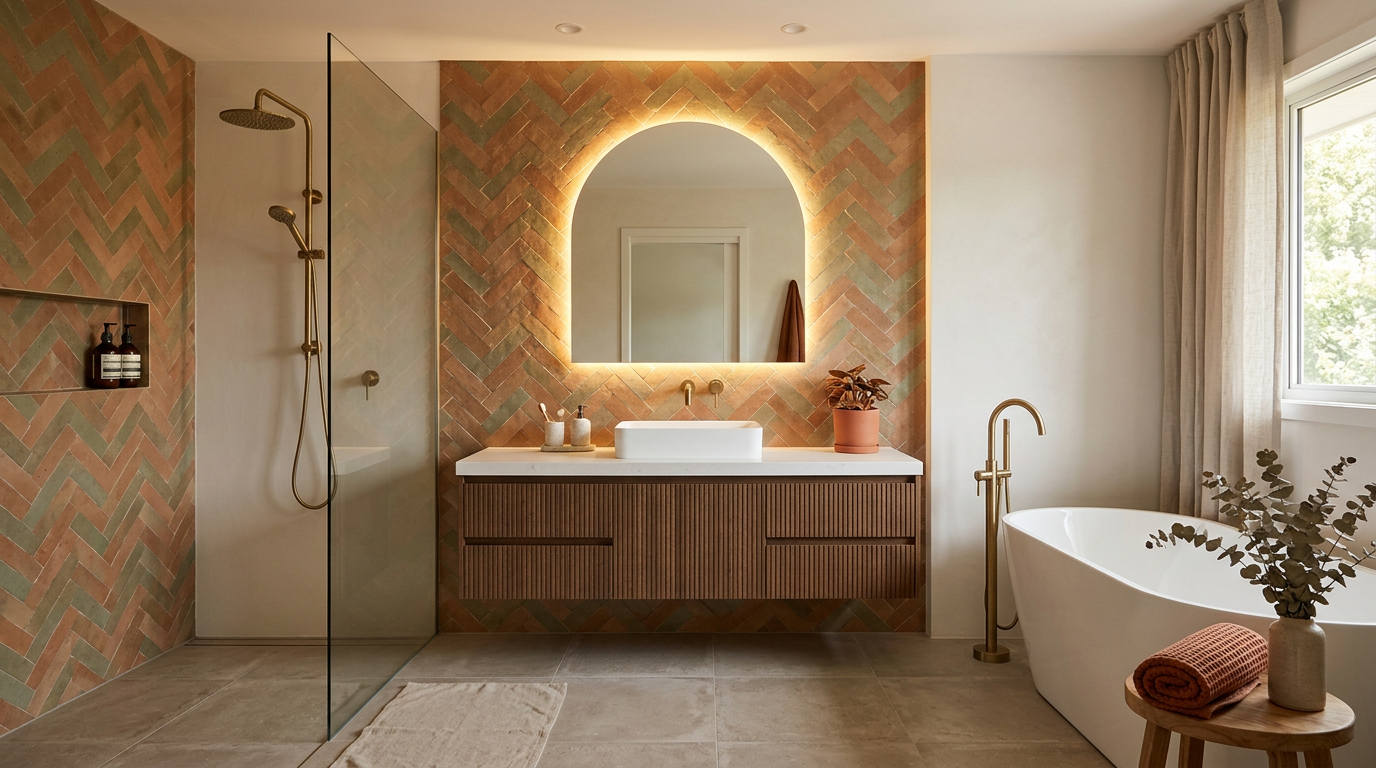
10 Bathroom Tile Trends for 2026: What's In and What's Out
- Tile drenching — using the same tile floor-to-ceiling — is the single biggest bathroom trend of 2026
- Warm earthy tones have fully replaced cool greys as the dominant color palette
- Large-format tiles (24"+ slabs) reduce grout lines and make small bathrooms read larger
- Zellige and handmade tiles command premium prices ($15–$40/sq ft) but deliver unmatched character
- Matte finishes are outselling gloss across every tile category
- Classic grey subway tile and small mosaic accent walls are fading fast
Tile is the single most design-defining material in a bathroom. It outlasts paint, fixtures, and vanities — often by decades — which means your tile choice carries real long-term weight. The trends landing in 2026 lean heavily toward warmth, texture, and commitment: bolder palettes, fewer grout lines, and surfaces that feel handcrafted rather than factory-perfect.
Here are the ten tile trends shaping bathroom renovations this year, what they cost, and which ones will still look sharp in 2036.
1. Tile Drenching
What it is: Floor-to-ceiling coverage in a single tile, eliminating visual breaks between surfaces. The same material wraps the floor, all four walls, and often the shower enclosure.
Why it’s popular: Tile drenching creates an immersive, spa-like atmosphere that photographs exceptionally well and reads as intentional rather than budget-driven. It also simplifies decision-making — one tile, one grout color, done.
Where to use it: Works best in primary bathrooms and wet rooms. In smaller bathrooms, choose a light-toned tile to avoid a cave effect.
Cost: $4–$18/sq ft for the tile itself; labor runs higher because of the increased square footage. Expect to budget for 30–40% more tile than a traditional floor-plus-shower approach.
Staying power: Trend-forward but increasingly mainstream. The technique itself is timeless (think traditional Turkish hammams and Italian marble bathrooms); it’s only the specific tile choices that date.
2. Large-Format Tiles (24” and Up)
What it is: Porcelain or ceramic tiles in sizes ranging from 24”x24” to full 48”x96” slabs. Fewer tiles mean fewer grout lines.
Why it’s popular: Minimal grout lines make cleaning easier and visually expand smaller spaces. Large-format tiles also showcase dramatic stone or marble patterns without interruption — a single veining pattern reads across an entire wall unbroken.
Where to use it: Shower walls, bathroom floors, and feature walls. Requires a very flat substrate; any floor irregularities become obvious with large format.
Cost: $3–$22/sq ft for the tile. Installation costs more — expect to pay a premium of $2–$5/sq ft over standard tile installation due to the weight, cutting complexity, and substrate prep required.
Staying power: Timeless. Large-format stone tiles have appeared in high-end bathrooms for centuries. The current porcelain versions simply make the look accessible.
3. 3D and Textured Tiles — Fluted, Wave, and Sculpted
What it is: Tiles with raised or carved surface relief — vertical fluting (reeded columns), undulating wave patterns, or geometric sculptural forms. The texture creates depth and shadow that flat tiles cannot.
Why it’s popular: Textured tiles add architectural interest without color risk. A fluted white tile wall in a monochrome bathroom adds visual richness while staying neutral. They also photograph extremely well in natural light.
Where to use it: Accent walls behind the vanity, shower niches, and bathtub surrounds. Use sparingly — an entire bathroom in heavy 3D texture becomes visually exhausting.
Cost: $8–$30/sq ft. Hand-sculpted versions trend toward the higher end. Installation requires more skill to keep grout consistent across relief surfaces.
Staying power: Mid-tier. Fluted surfaces in particular have broad staying power because they reference classical architecture. Novelty wave patterns may feel dated faster.
4. Zellige and Handmade Tiles
What it is: Zellige tiles are hand-cut, kiln-fired Moroccan clay tiles with naturally irregular edges and a glaze that varies subtly from piece to piece. “Handmade-look” tiles from domestic manufacturers approximate this effect at lower cost.
Why it’s popular: In an era of machine-perfect surfaces, zellige’s imperfection is the point. Each tile is slightly different in color, reflectivity, and shape — creating a surface that feels alive rather than manufactured.
Where to use it: Shower walls, backsplashes behind vanities, feature walls. The irregular surface means grout lines are inherently uneven; embrace it rather than fight it.
Cost: Authentic Moroccan zellige runs $15–$40/sq ft. Domestic zellige-style tiles: $6–$18/sq ft. Installation costs more because alignment requires more judgment than uniform tiles.
Staying power: High. Zellige has been produced in North Africa for over a thousand years and has cycled in and out of Western design for decades. The current wave is strong but not the first.
5. Warm Earthy Tones — Terracotta, Sage, and Taupe
What it is: A full palette shift away from cool whites and greys toward warm ochres, terracotta reds, dusty sage greens, and mid-tone taupes. This applies across tile types — ceramics, porcelain, and natural stone.
Why it’s popular: The cool minimalist bathroom has reached saturation. Warm tones feel grounded, organic, and connected to natural materials. They also photograph warm under incandescent and LED lighting, where cool greys often look clinical.
Where to use it: Floor tiles in terracotta work particularly well in Mediterranean and Spanish Colonial homes. Sage green subway tile on shower walls. Taupe large-format tiles as a neutral base for darker fixtures.
Cost: Comparable to equivalent tiles in any other color — typically $3–$15/sq ft depending on material and format. Terracotta-specific tiles vary widely; machine-made cement-look porcelain runs $3–$8/sq ft while handmade terracotta can reach $20+/sq ft.
Staying power: Very high for terracotta and warm neutrals — these reference centuries of Mediterranean architecture. Specific shades (e.g., trendy dusty pink-taupe) may date faster than classic burnt sienna.
6. Plaster-Effect and Limewash Tiles
What it is: Porcelain tiles engineered to mimic the soft, cloudy finish of traditional lime plaster or limewash paint — mottled, tonal, and deliberately imperfect. They deliver the organic plaster aesthetic without the maintenance and moisture vulnerability of actual plaster.
Why it’s popular: Organic, textural bathrooms have overtaken sterile minimalism. Plaster-effect tiles carry the aesthetic of a Venetian stucco wall or a Moroccan riad without requiring a specialized plasterer or ongoing sealing.
Where to use it: Shower walls, feature walls, and ceiling tiles (yes, ceiling tiles are having a moment alongside tile drenching). Pairs naturally with unlacquered brass or matte black fixtures.
Cost: $5–$20/sq ft. Most options are large-format porcelain, so factor in the installation premium.
Staying power: Strong for the next several years. The broader “organic texture” movement in interiors has deep roots and is not a flash trend.
7. Onyx-Effect Porcelain
What it is: Porcelain tiles digitally printed to replicate the translucent, veined appearance of natural onyx — typically in honey, green, grey, or white colorways. Unlike real onyx (which is fragile and expensive), porcelain versions are durable and consistent.
Why it’s popular: Natural onyx in a bathroom is a serious investment ($50–$200+/sq ft installed). Porcelain versions deliver the drama — dramatic translucency, bold veining, jewel-like color — at 10–20% of the cost.
Where to use it: Feature wall behind a freestanding tub, shower surround as a single statement surface, or a full tile-drenched powder room. Use it as the hero of the space, not a background.
Cost: $8–$25/sq ft for quality porcelain onyx-effect tiles. Installation standard.
Staying power: Moderate. The specific onyx look is peaking now. However, bold stone-effect tiles as a category have proven staying power at the high end of the market.
8. Matte Finishes Over Gloss
What it is: Not a tile shape or color, but a surface finish preference. Matte tiles have a non-reflective surface; glossy tiles reflect light like a mirror. In 2026, matte is decisively dominant.
Why it’s popular: Matte surfaces hide water spots, fingerprints, and soap scum far better than gloss — a practical advantage in a bathroom. They also photograph better (no blown-out reflections) and pair naturally with matte fixtures, which are themselves the dominant hardware finish.
Where to use it: Floor tiles should generally be matte regardless of trend (for slip resistance). For walls and shower surrounds, matte now reads as more refined than gloss in most contexts.
Cost: Equivalent to gloss options at every price point — finish choice does not typically add cost.
Staying power: High. Matte surfaces have been dominant in kitchen design for years; the bathroom is catching up. Gloss is not disappearing, but it’s receding from the default choice.
9. Natural Stone Looks in Porcelain
What it is: Advanced digital printing technology has made porcelain tiles nearly indistinguishable from natural marble, travertine, limestone, and quartzite — at a fraction of the cost and with dramatically better performance.
Why it’s popular: Natural stone requires regular sealing, is vulnerable to etching from acidic products, and varies unpredictably from slab to slab. Porcelain delivers the visual without the vulnerability. A 24”x48” porcelain tile that reads as Calacatta marble costs $8–$18/sq ft; the real thing starts around $40/sq ft and requires ongoing maintenance.
Where to use it: Anywhere you’d use real stone — floors, shower walls, feature walls. The quality gap between porcelain and stone has narrowed to the point where most visitors cannot tell the difference.
Cost: $5–$22/sq ft depending on quality and format. Premium Italian-manufactured porcelain slabs at the high end are worth the investment for large feature surfaces.
Staying power: Timeless by definition — these designs are approximating materials that have been used in bathrooms for millennia.
10. Bold Geometric Patterns
What it is: High-contrast geometric tile in encaustic cement, porcelain, or ceramic — Moroccan-inspired stars, Spanish hydraulic patterns, Art Deco fans, and contemporary angular forms. Often two-color (black/white, navy/white, terracotta/cream).
Why it’s popular: After years of restrained minimalism, pattern is back. Bold geometric floors in particular have migrated from boutique hotels into residential design, driven by social media exposure.
Where to use it: Floors only in most cases — a patterned floor with plain walls is a clean, intentional composition. Patterned walls risk visual overload. Powder rooms are the ideal proving ground for bold pattern.
Cost: Cement encaustic tiles: $10–$25/sq ft. Porcelain patterned tiles: $4–$15/sq ft. Installation labor is higher due to pattern-matching requirements.
Staying power: Moderate to high. Classic geometric and hydraulic patterns have a long design history. Very contemporary abstract patterns may date faster.
Trend vs. Cost vs. Durability: Quick Reference
| Trend | Cost (per sq ft) | Durability | Staying Power |
|---|---|---|---|
| Tile Drenching (technique) | Varies by tile | High | High |
| Large-Format Tiles (24”+) | $3–$22 | Very High | Timeless |
| 3D / Fluted / Wave | $8–$30 | High | Moderate–High |
| Zellige / Handmade | $6–$40 | Moderate (walls only) | High |
| Warm Earthy Tones | $3–$20 | High | Very High |
| Plaster-Effect / Limewash | $5–$20 | Very High | High |
| Onyx-Effect Porcelain | $8–$25 | Very High | Moderate |
| Matte Finish | Same as gloss | High | High |
| Natural Stone-Look Porcelain | $5–$22 | Very High | Timeless |
| Bold Geometric Patterns | $4–$25 | High | Moderate–High |
What’s Out
Three tile trends that peaked and are now fading:
Small mosaic accent walls. The 2”x2” glass mosaic feature wall — once a spa-bathroom staple — now reads as early 2010s. If you have one, it’s not urgent to replace, but avoid installing new ones.
Grey subway tile. Ubiquitous in kitchen and bathroom renovations from roughly 2012–2022, grey subway tile is the new beige — technically inoffensive, but carrying a strong timestamp. White subway tile retains its classic status; grey does not.
Busy mixed-pattern combinations. The maximalist “more is more” tile approach — geometric floor, patterned shower wall, mosaic niche — has given way to a more disciplined use of pattern. One strong tile choice per space, executed well.
Practical Advice: Balancing Trend with Timelessness
Tile replacements are expensive and disruptive — budget $8,000–$20,000 for a full bathroom re-tile, depending on size and materials. See our full bathroom remodel cost guide for detailed numbers. Given that lifespan, the tile-selection framework that holds up is: timeless foundation, trend in one element.
Apply this in practice:
- Use a neutral large-format tile for the floor (timeless) and introduce zellige or a bold geometric on a single feature wall (trend).
- Choose a stone-look porcelain for the shower surround (timeless) and bring warmth through earthy grout color and matte fixtures (lower-cost, easy to update).
- Commit to tile drenching if you love it, but choose a genuinely neutral tone — warm white, soft taupe — rather than a specific “trendy” color.
The trends with the highest staying power in 2026 — natural stone looks, large-format tile, matte finishes, and warm neutrals — are all aligned with the timeless end of the spectrum. You don’t have to choose between current and lasting. The best tile choices for 2026 are both.
For guidance on choosing the right material for each surface specifically, see our guide to the best tile for bathroom floors.
- Are you experienced with large-format tile installation, including substrate leveling?
- What adhesive and setting materials do you use for large slabs or heavy stone-look porcelain?
- Can you show examples of zellige or handmade tile installations you've done?
- How do you handle grout color selection for irregular or handmade tiles?
- What is your process for waterproofing the shower surround before tiling?
- Will you provide a tile layout drawing before starting, so I can approve the pattern orientation?
- What is your policy on tile breakage — do I need to supply extra, or do you account for waste in the quote?
- Are you licensed and insured for tile work in this state?
The Bottom Line
The 2026 bathroom tile landscape rewards commitment and restraint in equal measure. The most compelling spaces commit fully to one strong choice — drenching a bathroom in a single warm-toned plaster-effect tile, or laying a bold hydraulic cement floor under otherwise plain white walls — rather than hedging with safe, forgettable combinations.
Trends worth following without hesitation: large-format tile, matte finishes, warm earthy tones, and natural stone-look porcelain. These are aligned with timeless design principles and will age well.
Trends to approach selectively: zellige (use on walls, not floors), onyx-effect porcelain (one statement surface, not the whole room), 3D textured tiles (one wall, not four).
Grey subway tile, small mosaic accent walls, and cool-white-everything bathrooms had a long run. The palette has turned. The installations happening in 2026 will define what feels current well into the 2030s — choose accordingly.
Deep Dive: More on Bathroom Remodel
How Long Does a Bathroom Remodel Take? A Timeline Guide
A bathroom remodel takes 2-8 weeks depending on scope. See phase-by-phase timelines, common delays, and how to keep your project on track.
How to Choose a Bathroom Vanity: Sizes, Styles, and What to Look For
A complete guide to choosing the right bathroom vanity. Covers sizes, materials, countertops, sinks, and costs for every budget.
Do You Need a Permit for a Bathroom Remodel? Here's When It's Required
Find out which bathroom remodel projects need permits and which don't. Covers costs, process, and what happens if you skip them.
Best Tile for Bathroom Floors: A Complete Comparison Guide
Choosing bathroom floor tile? Compare porcelain, ceramic, natural stone, and vinyl by cost, durability, water resistance, and maintenance.